The Mortgage Market Has a New Gatekeeper: Artificial Intelligence
November 16, 2026
Dr. Ilya Zheludev Hyponomy

Summary: The next mortgage broker may not be human. Artificial intelligence is beginning to reshape how Canadians discover, compare and apply for mortgages. For first-time buyers, AI assistants promise to simplify an increasingly complicated financial decision. For lenders and brokers, however, the implications run deeper. As mortgage searches migrate from traditional websites and comparison platforms into AI conversations, visibility, accessibility and the ability to act on a borrower’s request may become as important as the interest rate itself. A proposed industry-wide AI mortgage registry, supported by the Canadian Lenders Association, could help ensure that this emerging distribution channel remains open, competitive and accessible to lenders of every size.
For decades, the mortgage industry has competed for borrowers through branches, brokers, advertising and, more recently, digital comparison platforms. Artificial intelligence threatens to rearrange that hierarchy. The next generation of homebuyers may never begin their mortgage search on a bank’s website. They may simply ask an AI assistant to find the best mortgage for them.
That apparently modest change has profound implications for how mortgages are distributed, how lenders compete and who ultimately controls the customer relationship.
Consider the first-time buyer. Purchasing a home is among the most consequential financial decisions most Canadians will make, yet the process remains bewilderingly complicated. Down payments, closing costs, mortgage insurance, amortization periods and qualification rules create a maze of decisions that even financially sophisticated consumers struggle to navigate.
According to CMHC’s 2026 survey, first-time buyers spent an average of 4.7 years saving for a down payment. More than one-third encountered unexpected costs. Three-quarters of first-time buyers searching for mortgage information did so online, and 23% of that group were already using AI to explore their options.
This is not merely a technological curiosity. It is an early indication that the mortgage customer’s journey is changing.
The broader evidence points in the same direction. A Scotiabank survey found that 37% of Canadian adults surveyed used AI to help manage their finances. Research from the Canadian Internet Registration Authority found that 46% of Canadian adult internet users had used generative AI in the preceding year, with more than half of those users employing it as a search engine.
For lenders, the question is no longer whether consumers will use AI to research financial products. It is whether their own products will be visible, intelligible and accessible when they do.
The best mortgage may not have the lowest rate
Mortgage competition has traditionally revolved around price, product terms, service and relationships. AI introduces another dimension: the ease with which a borrower can complete a transaction.
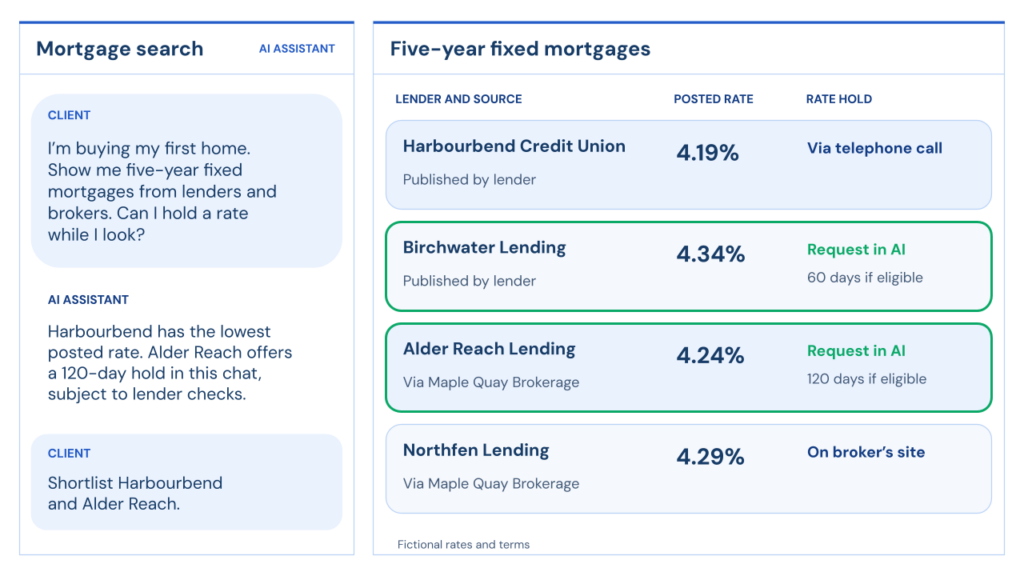
Imagine a first-time buyer asking an AI assistant to compare five-year fixed mortgages and identify lenders willing to hold a rate while they search for a property.
One lender offers a rate of 4.19%, but requires a telephone conversation before granting a rate hold. Another offers 4.24%, with a 120-day rate hold that can be requested directly through the AI assistant.
The borrower chooses the second lender.
The example is hypothetical, but its economic logic is compelling. The difference of five basis points matters, yet so does the inconvenience of leaving a digital conversation, navigating another website, completing additional forms or waiting for a callback.
For a generation accustomed to instantaneous digital services, friction has become a competitive disadvantage.
This does not mean that borrowers will abandon price sensitivity or professional advice. It means that the experience of obtaining a mortgage may increasingly influence which lender is selected.
A lender with an excellent product but no meaningful presence in AI could find itself invisible at precisely the moment a borrower is making a decision.
From searching to acting
Today’s AI assistants can already help consumers understand mortgage terminology, estimate payments and compare publicly available information. The more consequential development will come when these systems can act on a borrower’s behalf.
A consumer might ask an AI assistant to identify suitable mortgages, request a rate hold or initiate a preapproval application. A personal AI agent could monitor available products over time and notify the borrower when a more attractive option emerges.
Eventually, with appropriate authorization and secure connections, such an agent could submit information to a lender and receive a conditional preapproval without requiring the borrower to navigate every step manually.
The distinction between providing information and executing an authorized transaction is critical.
An AI assistant reading a lender’s public website may encounter outdated rates, incomplete product details or application processes designed exclusively for human users. A direct, approved connection would instead allow the lender to determine what information is available, which actions are permitted and how requests are processed.
The lender would continue to apply its own underwriting standards. Brokers would remain responsible for advice. Borrowers would retain control over the information they authorize an AI system to share.
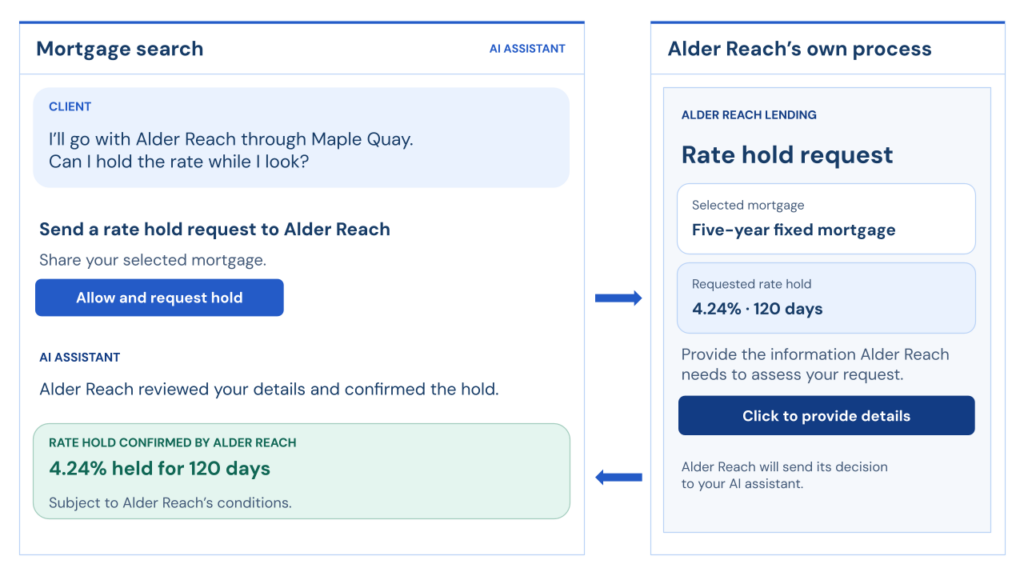
In other words, AI could become a new interface to the mortgage market without becoming the institution making the mortgage decision.
That distinction also matters for consumer trust. TD’s 2026 research found that 59% of surveyed Canadians were comfortable with banks using AI when meaningful human oversight was maintained. For loan and other financial product approvals, 55% preferred decisions assessed entirely by people.
Consumers may welcome automated convenience without surrendering the reassurance of human accountability.
Who controls the new gatekeeper?
The industry’s larger concern should be the concentration of distribution power.
Mortgage brokers and comparison websites have long served as intermediaries between borrowers and lenders. AI assistants may become another intermediary, but potentially one with extraordinary influence over which financial products consumers encounter.
If a handful of technology platforms become the primary gateways to mortgage discovery, the industry risks replacing one set of distribution dependencies with another.
Smaller lenders could be particularly vulnerable. A credit union or specialized mortgage provider may offer a compelling product but lack the resources to negotiate individual integrations with every major AI platform.
This is where an industry-wide response becomes important.
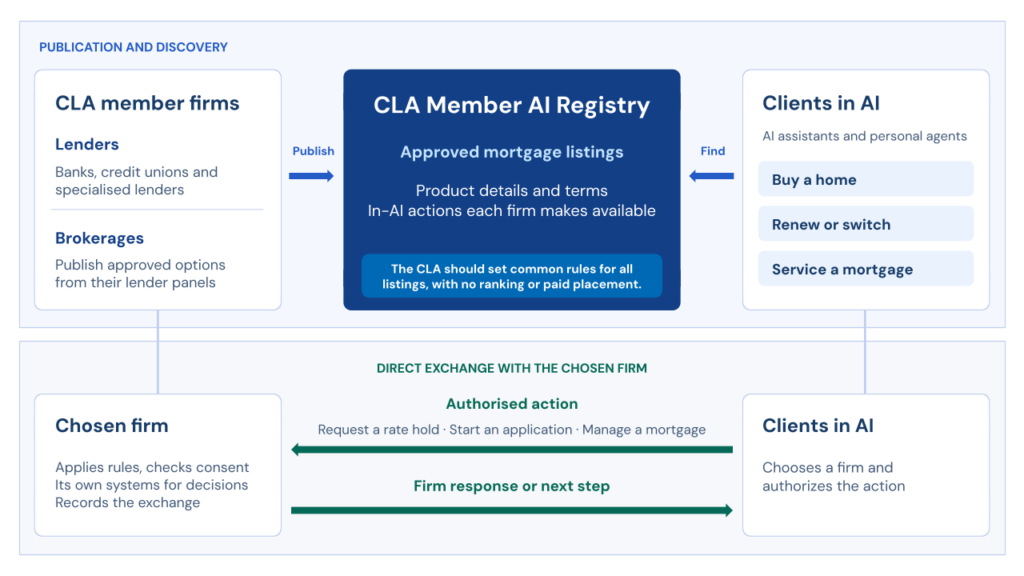
The Canadian Lenders Association has an opportunity to help establish a common mortgage registry designed for AI assistants and personal AI agents.
Under such a model, participating lenders and brokerages would publish approved information about their mortgage products and services. They would specify which AI-enabled actions they support, from requesting advice to initiating an application, and establish secure connections through which authorized requests could reach their existing systems.
The registry would serve as a common discovery mechanism rather than another mortgage brokerage or comparison platform.
Importantly, it should operate without paid placement, preferential ranking or commercial bias. Participating institutions would compete on the merits of their products and services, rather than their ability to purchase visibility.
Each institution would remain free to publish through its own channels and other registries. The objective would not be to create another gatekeeper, but to prevent the emergence of one.
For Canada’s diverse lending ecosystem, including banks, credit unions, alternative lenders and independent brokerages, that distinction is essential.
A new opportunity for mortgage competition
The federal government’s renewed emphasis on competition in financial services makes this development particularly timely.
Canada does not simply need more lenders. It needs better ways for consumers to discover and access the lenders that already exist.
AI could help accomplish that by reducing the search costs that have historically favoured large, established financial institutions.
A borrower who might never encounter a regional credit union or specialized mortgage provider through conventional advertising could discover its product through an AI assistant comparing eligible options.
For brokerages, AI could provide a new way to present products from their lending panels and connect borrowers with professional advice. For lenders, it could create a more direct route from product discovery to application.
Open banking could eventually extend these capabilities further. With appropriate consent, consumers could authorize the secure sharing of selected financial information, reducing repetitive documentation and allowing lenders to assess applications more efficiently.
But none of this is inevitable.
The benefits depend on reliable product information, clear consumer consent, appropriate privacy protections, secure integrations and a distribution model that does not favour the largest institutions.
Hyponomy is among the Canadian companies developing infrastructure to make approved financial services accessible through AI while allowing institutions to retain control over their customer relationships and internal processes.
The technology is emerging. The industry’s governance and commercial arrangements must evolve alongside it.
The race to be found.
The mortgage industry has spent decades making it easier for borrowers to find financing. AI may fundamentally change what being found means.
A competitive rate will remain important. So will underwriting expertise, trusted advice and customer service. But increasingly, lenders will also need to ensure that their products can be discovered and acted upon within the digital environments consumers choose to use.
The institutions that recognize this shift early will have an advantage. Those that treat AI as merely another marketing channel may discover that the customer relationship has already moved elsewhere.
For the Canadian Lenders Association, the opportunity is to help shape this emerging market before its rules are written by others.
The future of mortgage competition should not depend on which lender has the largest advertising budget or the closest relationship with an AI platform. It should depend on which institution offers the most suitable financing to the borrower.
AI could make Canada’s mortgage market more open, transparent and competitive.
But only if the industry ensures that the new gatekeeper keeps the gate open.
Five Key Takeaways
- AI is becoming a mortgage distribution channel. First-time buyers are already using AI to research financing, creating a new point of competition for lenders and brokers.
- Convenience may influence mortgage selection. Competitive rates remain essential, but the ability to request a rate hold, obtain advice or begin an application within an AI conversation could increasingly affect borrower decisions.
- Lenders must retain control. AI assistants should operate through approved connections, with explicit consumer authorization, secure information exchange and underwriting decisions remaining with financial institutions.
- The CLA has an opportunity to establish industry infrastructure. An impartial mortgage registry could make products from banks, credit unions, alternative lenders and brokerages discoverable across multiple AI platforms without paid placement or preferential treatment.
- The future of competition depends on open access. AI could lower barriers to mortgage discovery and help smaller lenders reach new borrowers, provided the industry avoids replacing existing distribution dependencies with a handful of powerful technology gatekeepers.
Dr. Ilya Zheludev is Founder and CEO of Hyponomy, a Canadian company developing infrastructure that connects financial institutions with AI assistants and personal AI agents.