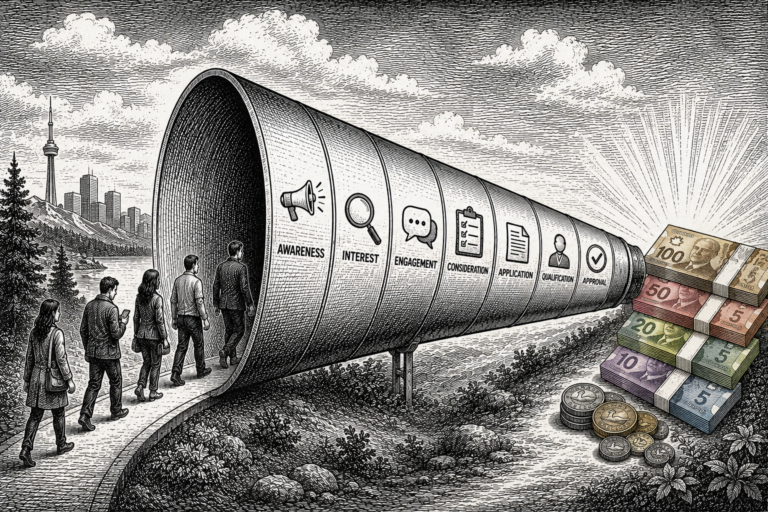
Faster Developers, Slower Companies: The AI Productivity Conundrum
November 1, 2026
Gary Schwartz Canadian Lenders Association

Abstract: AI is accelerating individual productivity, but companies are struggling to convert those gains into stronger business performance. Research involving more than 500,000 software developers reveals a striking gap between increases in coding activity and finished software. For investors and financial institutions, the challenge is no longer simply encouraging employees to adopt AI. It is redesigning the processes, incentives and management structures that turn faster individual work into lower costs, better products and stronger economic returns.
Technology companies are in a productivity race. From founders working out of their garage to established banks, engineers are using AI to varying degrees to accelerate product development, increase output and reduce engineering costs. For investors, the promise is compelling: companies that can build better products faster, with fewer resources, should earn stronger returns.
This topic is the throughline of most Finance Event‘s panels. It was the topic at the table this past week with a group of investors in a fund we manage. We discussed how AI is changing how engineering teams and lone-wolf developers code. While writing code with AI is becoming expected, executives increasingly want evidence that their investment is producing measurable gains. The question are grappling with is how best to measure engineering productivity as a developer and more importantly as a development team.

The evidence of individual productivity gains seems clear. A 2026 study published in Management Science examined 4,867 software developers across Microsoft, Accenture and a Fortune 100 company. Researchers found that access to AI coding assistance increased completed tasks by approximately 26%. Less experienced developers generally adopted the tools more readily and experienced greater gains.
Earlier research on GitHub Copilot found that developers using AI completed a programming task 55.8% faster than those working without it. This research suggests that AI can dramatically improve the productivity of certain engineering activities, potentially changing the economics of software development.
However, the benefits are neither universal nor predictable. In a 2025 experiment involving 16 experienced open-source developers completing 246 real-world tasks, researchers at METR found that AI actually increased completion times by 19%. Remarkably, the developers believed the technology had made them approximately 20% faster. A subsequent 2026 investigation suggested that newer AI tools might be improving productivity, although the researchers could not reliably quantify the gains.
Here is the conundrum … AI adoption and usefulness depends on the task, the engineer’s experience and the environment in which the technology operates. More importantly, they expose a fundamental measurement problem: producing more code and delivering more valuable software are different achievements.
A September 2026 National Bureau of Economic Research study provides perhaps the clearest proof. Researchers examined more than 500,000 GitHub developers and measured the impact of successive generations of AI coding tools. Basic autocomplete tools were associated with a 30% increase in coding activity. Interactive coding agents increased activity by 180%, while autonomous agents produced a cumulative increase of 240%.
Yet the gains diminished dramatically as researchers moved closer to finished products. The 240% increase in coding activity translated into an 80% increase in projects and only a 30% increase in actual software releases.
The difference is striking. AI can accelerate code production enormously without producing anything close to the same improvement in finished software.
When AI accelerates one activity without changing the processes surrounding it, the bottleneck simply moves elsewhere. The researchers described this as a weak-link problem. Software development requires more than writing code. That code must be:
1. reviewed
2. tested
3. secured
4. integrated
5. released.
This is the emerging AI productivity conundrum. An individual engineer can adopt an AI assistant almost overnight without requiring the rest of the company to change. But when an entire engineering team accelerates its output, the organization must reconsider how work moves between employees, departments and systems.
The challenge is no longer simply technological. It becomes organizational.
Canadian technology companies are beginning to confront this distinction. In 2025, Shopify CEO Tobi Lütke made AI proficiency an expectation across the company and required teams seeking additional employees to demonstrate why AI could not accomplish the work. His warning that “stagnation is slow-motion failure” reflected a broader shift in management thinking.
The more consequential aspect of Shopify’s approach is its implication for capital allocation. Before adding employees, managers must reconsider whether existing work can be completed differently. AI is not simply another tool to make employees faster. It is an opportunity to challenge the assumptions behind how companies organize and resource their operations.
At Wealthsimple, chief technology officer Diederik van Liere has described how AI-assisted engineering is changing software development. In an October 2026 interview, he observed that employees thriving with AI tend to demonstrate initiative, curiosity and a willingness to experiment. Yet as development accelerates, the processes responsible for reviewing and validating code must also evolve. Faster engineering output creates little value if the organization cannot reliably convert it into finished products.
The difficulty is that individual adoption and organizational transformation require very different kinds of change. An engineer can decide to use AI independently. Redesigning an engineering organization requires agreement on responsibilities, quality standards, workflows and performance measures. It may also require eliminating established processes and challenging management structures that have existed for years.
The same problem extends well beyond software engineering.
A study published in The Quarterly Journal of Economics examined more than 5,000 customer-support employees and found that AI assistance increased productivity by approximately 15% on average. Less experienced workers benefited particularly strongly, suggesting that AI can help transfer the knowledge and practices of experienced employees to their colleagues.
These gains are economically meaningful. But increasing the number of customer interactions an employee can handle does not necessarily improve the overall customer experience. If complex problems still require escalation through unchanged processes, the organization may simply move customers toward the next bottleneck more quickly.
For Canadian financial institutions, the implications are substantial. Banks, credit unions, alternative lenders and fintech companies operate through interconnected processes involving underwriting, fraud prevention, compliance, servicing and collections. Improving the productivity of one function does not automatically improve the economics of the entire institution.
An AI-enabled underwriter might assess applications twice as quickly, identifying inconsistencies and preparing recommendations in a fraction of the previous time. But if fraud verification, credit policy and final approval continue operating at their previous speed, the lender may simply accumulate a larger backlog of unfinished applications. The underwriting dashboard improves while the borrower continues waiting.
The same applies to fraud prevention. AI can identify suspicious transactions and generate alerts at unprecedented speed. But unless investigators can prioritize and resolve those alerts more effectively, the institution may create additional work rather than prevent additional fraud.
In collections, AI can automate communications and recommend repayment strategies. Yet the relevant measure is not the number of messages generated. It is whether the institution improves recoveries, reduces servicing costs and delivers better customer outcomes.
Financial institutions face an additional challenge because productivity improvements must be balanced against regulatory obligations, consumer protection and risk management. Eliminating controls to accelerate throughput can destroy economic value rather than create it.
The opportunity is therefore not simply to make every employee faster. It is to redesign the entire lending process so that improvements in one function translate into better outcomes across the institution.
Canadian economic research suggests that this organizational challenge may be central to realizing AI’s broader productivity benefits.
In April 2026, Statistics Canada examined the relationship between AI adoption and business productivity. At first glance, the results were encouraging. Businesses adopting AI exhibited labour productivity levels 16.8% higher than non-adopters.
But the relationship weakened as researchers accounted for other factors. Controlling for companies’ existing productivity reduced the difference to 10.2%. Once the analysis incorporated complementary capabilities such as research and development, cloud computing, data analytics and workforce training, the difference fell to 5.1% and was no longer statistically significant.
The finding does not mean AI fails to improve productivity. Rather, it suggests that much of the apparent advantage enjoyed by AI adopters may reflect the broader capabilities of those businesses. Companies with better infrastructure, stronger management and a history of innovation may be better positioned to benefit from new technology.
The Bank of Canada identified a similar disconnect in August 2026. Although more than two-thirds of surveyed business leaders reported personally using AI during a typical workweek, only 8% of firms reported significant AI use in their core operations.
That is a remarkable divide between individual enthusiasm and organizational transformation. Executives are becoming comfortable using AI themselves, but their companies are finding it considerably harder to incorporate the technology into how business is actually conducted.
This brings us to a less comfortable conclusion. The principal constraint on enterprise AI productivity may not be the technology or the employees. It may be management’s ability to reorganize work.
Individual employees can adopt AI without fundamentally changing their organizations. Enterprise transformation requires departments to reconsider responsibilities, eliminate redundant processes, coordinate information and sometimes surrender control over activities they have managed for years.
These are difficult management decisions. They are also decisions that traditional corporate incentives do not always encourage.
Department heads are frequently rewarded for improving the performance of their own functions rather than the efficiency of the organization as a whole. An underwriting team might celebrate a 50% reduction in processing time while the lender’s overall approval process remains unchanged. From the department’s perspective, AI has succeeded. From the customer’s perspective, little has improved.
As an investor, I am increasingly skeptical of AI strategies measured primarily through adoption rates, software expenditure or theoretical hours saved. These figures may demonstrate activity, but they do not establish economic value.
Saving time matters only if a business uses it to do more, reduce costs or improve service. Faster software development should bring products to market sooner. Automated underwriting should help lenders serve customers more efficiently while maintaining credit standards.
The real test is business performance. Are products launching sooner? Is revenue per employee rising? Are profit margins improving? Are servicing costs falling while customers still receive good service? Are returns improving after accounting for risk?
Consider two lenders buying the same AI underwriting system. One gives it to employees but keeps every existing approval, verification and documentation step. The other redesigns the lending process, using automation alongside human judgment and clear risk controls.
Both have adopted AI, and both may save employees time. But the financial gains depend on how well management turns that saved time into a better lending process.
Canada’s productivity challenge makes this distinction particularly consequential. Statistics Canada reported that 12.2% of Canadian businesses used AI to produce goods or deliver services in 2025, double the proportion a year earlier. Adoption is accelerating, but the evidence of corresponding productivity improvements remains less conclusive.
Canada has considerable strengths in AI research and technological innovation. Yet those advantages will mean little to the broader economy unless businesses can translate them into better products, more efficient operations and stronger financial performance.
It is easy to mistake AI adoption for success. Employees are using it, developers are producing more code and managers are reporting time savings. But those gains can stall when they reach other departments, outdated systems, regulatory requirements or teams working toward different goals.
The technology CEO who dismissed his slower engineers may have kept those who use AI best. But he may not have fixed what is slowing his company down. When engineers produce more, managers must turn that extra work into finished products.
The irony is that AI may reveal management weaknesses more clearly than employee weaknesses. Technology companies entered this race to get more from their engineers. The winners will be those that make the whole business work better.
Five Key Points
- AI is producing measurable individual productivity gains. Research involving 4,867 software developers found a 26% increase in completed tasks, while other experiments demonstrated substantially faster coding performance.
- Faster coding does not translate directly into faster software delivery. A 2026 study of more than 500,000 developers found that autonomous AI agents increased coding activity by 240%, compared with a 30% increase in software releases.
- Organizational change is the greater challenge. AI adoption requires companies to redesign reviews, approvals, responsibilities and workflows rather than simply providing employees with new tools.
- Canadian research reveals a gap between AI adoption and economic performance. Statistics Canada found that the apparent productivity advantage of AI adopters diminished after accounting for complementary investments, while the Bank of Canada reported that only 8% of surveyed firms used AI significantly in core operations.
- Investors and lenders must measure economic outcomes rather than technological activity. Delivery times, operating costs, revenue per employee, customer outcomes and risk-adjusted returns provide more meaningful evidence of AI’s value.