



Carla Potter
Partner

Brian Walmsley
Managing Director

Michael McGhee
SVP & Head, TD Auto Finance Canada

Ian Benaiah
Managing Director
Capital Strategies: Who’s Financing Canada’s Auto Market in 2026?
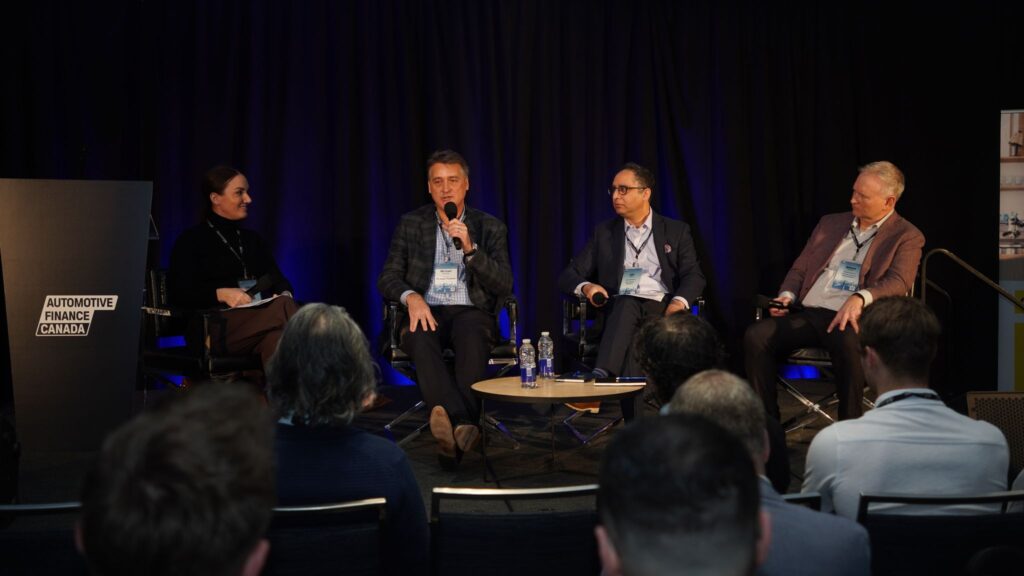
Abstract: In the opening panel on capital strategies, Carla Potter (Cassels) moderated a discussion with Brian Walmsley (Sun Life), Ian Benaiah (RBC) , and Michael McGhee (TD) on the evolving landscape of auto finance. The panel explored whether capital providers are pulling back amid economic volatility, how securitization and private credit are shaping funding markets, and what lenders now require from borrowers in an era of heightened fraud scrutiny. While uncertainty remains heading into 2026, the message from capital providers was consistent: capital is still available—but governance, transparency, and disciplined operators are now more important than ever.

 Check out the full VIDEO here.
Carla Potter: It’s been a pretty interesting 2025, and it looks like 2026 may be equally interesting. We’ve seen political tensions, tariff wars, and interest rates moving in a more positive direction—but there’s still uncertainty. There have been rumors that capital providers are pulling back. Yet what we’re hearing is that capital is still there—it’s just more selective. Ian, what are you seeing?
Ian Benaiah: Selectivity is definitely the right word, but I want to emphasize that we’re still leaning in. At RBC, our Canadian securitization business works with a wide range of clients—from smaller regional originators to multinational captives. We finance loan, lease, and floorplan collateral across the market.
What’s interesting is that the market itself has grown about 30% in the past two years, and the automotive sector represents roughly 40% of the overall securitization market. So we’re actually seeing strong growth.
Where selectivity comes in is through deeper diligence. We look closely at origination and servicing capabilities, underwriting standards, and performance trends. But broadly speaking, if we financed collateral last year and it performed well, we’re comfortable financing it again—and in some cases even expanding.
One area where we’re cautious is EV leases with residual value risk, simply because the long-term value curve is still uncertain.
Carla Potter: Brian, does that resonate from the Sun Life perspective?
Brian Walmsley: Very much so. We operate in a similar way, although we sometimes get more granular within the credit box. For us, the key factor is always the originator. If they’ve been through cycles before—if they’ve got the battle scars—we often learn a lot from them.
One important point is that when others pull back, that’s often when great opportunities appear. Some of the strongest originators write their best deals in tougher markets.
So we’re not afraid to enter a relationship cautiously—perhaps starting with a smaller portion of a deal and learning the business. But we’re not looking to sit on the sidelines either.
Carla Potter: Let’s address the elephant in the room. It’s been a tough few years with insolvencies and high-profile cases like Pride and Tine. Fraud—especially “bust-out” fraud—is becoming more prevalent. Michael, has that changed how TD approaches risk or trust?
Michael McGhee: I wouldn’t say it has changed our risk appetite, but it has definitely changed the trust equation.
Auto finance has always been a trust-based business. You put processes in place to verify that trust—but now we’re verifying more frequently. That means stronger monitoring, more frequent checks, and closer oversight of the originators and dealers we work with.
It’s also forcing smaller players to operate with more discipline. Lenders are exercising audit rights more frequently and increasing reporting expectations.
Carla Potter: Ian, has the securitization side of the market changed because of these events?
Ian Benaiah: Not dramatically in terms of structure. The methodologies we use to structure transactions are well established. But we are paying closer attention to diligence and controls.
For example, we continue to rely on agreed-upon procedures audits, backup servicers, legal opinions, and strong cash management structures. But we’re also scrutinizing things like:
-
Governance and ownership structures
-
Infrastructure and reporting capabilities
-
Servicing quality and liquidity strength
-
Ensuring there’s no double pledging of assets
Those fundamentals have always mattered, but they’re under an even brighter spotlight now.
Carla Potter: Brian, if a deal looks good on paper, what’s the one thing that can make it unfinanceable?
Brian Walmsley: Often it comes down to the strength of the financial leadership within the company. When the CFO has deep knowledge of the business and can confidently explain the data and the funding model, that speaks volumes.
If that role isn’t operating at full capacity—if the company can’t clearly explain its numbers—that’s a red flag.
Carla Potter: Michael, does that align with what you’re seeing on the originator side?
Michael McGhee: Yes, absolutely. We may have different customers, but we’re looking for the same attributes: sophistication, discipline, and strong processes.
For smaller operators, we increasingly want to see evidence that they can manage risk and absorb losses if necessary. Five years ago, many lenders would sign on new providers with relatively little diligence. Today, that diligence has increased significantly.
Carla Potter: If governance, performance history, and data quality are all important, which one matters most?
Ian Benaiah: They really operate like a three-legged stool. If one leg is missing, the stool doesn’t stand.
But if I had to highlight one, governance is probably the hardest to overcome. Performance anomalies can sometimes be explained, and data limitations can be addressed through assumptions or structural protections. Governance failures are much harder to mitigate.
Carla Potter: Let’s talk about tail risk. When losses occur, who ultimately bears them?
Ian Benaiah: In securitization structures, the issuer retains the first loss. Our structures are typically designed to achieve a AAA-equivalent rating, so the goal is to minimize risk to senior investors.
That alignment is important because it incentivizes the issuer to maintain portfolio quality and strong servicing practices.
Michael McGhee: From the originator side, we ultimately bear the risk as well. When we make a credit decision and the loan goes bad, the bank absorbs the loss.
Brian Walmsley: The same alignment exists in bilateral lending. In forward-flow structures—where risk transfer is more direct—data quality becomes even more critical, because investors rely heavily on historical performance to predict future outcomes.
We’re also seeing private credit play a larger role in the ecosystem, sometimes providing mezzanine capital that acts as an additional shock absorber within structures.
Carla Potter: As we look ahead to 2026, what’s one piece of advice you’d give borrowers or lenders trying to navigate this environment?
Ian Benaiah: Be transparent. Don’t hide your blemishes. If we understand the issues, we can structure around them. But we need confidence in the information we’re receiving.
Brian Walmsley: I’d echo that. Transparency builds trust. Our business is based on deep relationships—many lasting 20 years or more. If borrowers can bring problems forward openly, lenders are often willing to help work through them.
Michael McGhee: For me, it comes down to KYC discipline. Dealers and originators need to take responsibility for knowing their customers. Fraud prevention starts at the front end. If that step isn’t done properly, no downstream control will fully fix the problem.
Here are 10 key insights from the panel:
-
Capital hasn’t disappeared—it’s become more selective
Lenders remain active in the market, but they are focusing more heavily on governance, transparency, and disciplined operators. -
Securitization markets remain strong
The Canadian securitization market has grown roughly 30% over the past two years, with auto finance representing nearly 40% of the total market. -
EV residual risk remains an open question
Uncertainty around long-term EV values makes certain lease structures harder to finance. -
Fraud has changed the trust equation
Recent industry events have prompted lenders to increase verification, auditing, and reporting requirements. -
Governance is the hardest risk to mitigate
Performance issues and data gaps can sometimes be structured around, but governance failures are far more difficult to overcome. -
Originators still bear the first loss
In securitization structures, issuers retain first-loss exposure, aligning incentives between lenders and originators. -
Transparency strengthens lender relationships
Lenders often prefer borrowers who openly discuss past challenges and demonstrate learning from them. -
Strong financial leadership matters
Companies with CFOs who deeply understand the business and data tend to inspire greater lender confidence. -
Private credit is becoming an important funding layer
Private credit providers are increasingly filling mezzanine positions within financing structures. -
KYC discipline is the first line of defense against fraud
Effective customer verification at the dealer and originator level is essential to maintaining trust and protecting capital.
Sign up for the CLA Finance Summit Series
