
 Event Insights
Reading the Signals: How Early Data Is Reshaping Auto Finance Risk
March 22, 2026

Reading the Signals: How Early Data Is Reshaping Auto Finance Risk
Abstract: In this keynote, Sarah Petryna (Senior Director, Product, Dealertrack) shared new Dealertrack analysis on how fraud in automotive finance increasingly comes down to the misappropriation of information—whether identity data, income details, housing costs, or other application elements. Drawing from the massive volume of applications flowing through Dealertrack’s ecosystem, Petryna explained how the company analyzed consumer behavior between rooftops and dealer behavior between lenders to identify patterns that may indicate fraud, bust-outs, or other forms of manipulation. Her central point was that fraud is no longer just an IDV conversation: lenders and OEMs need better insight into how application details change across the buying journey, which scenarios are most predictive of repossession, and how shared ecosystem intelligence can help the industry respond earlier and more effectively.
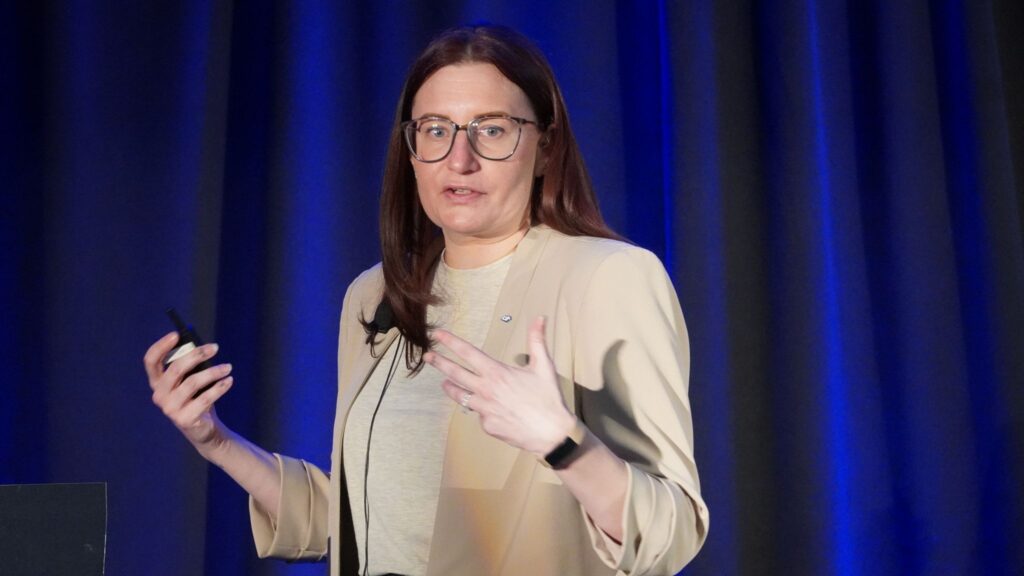

👉 Check out the full VIDEO here.
Sarah Petryna: There’s a bit of a fraud problem in auto. Everyone knows that identity fraud is a major issue, and there’s no shortage of conversations in the market about IDV. But this is not just an IDV conversation.
The other big buckets of fraud include income fraud, document and signature forgery, bust-out fraud, and then the dreaded “other” category that catches everything else. What ties all of these together is the same thing: the misappropriation of information.
Whether it’s identity information, inflating income a little to secure a cleaner approval, or changing housing details to improve affordability, the common thread is that the information being presented is not always the same or not always accurate.
Sarah Petryna: The average consumer visits 2.1 rooftops for every vehicle purchase. Each of those rooftops submits an average of 2.6 credit applications. So if someone like Jackie Barker is out shopping for a car and visits two rooftops, that can easily translate into six credit applications existing in the ecosystem for a single purchase.
That’s a lot of data. At any given moment, there are about 1.2 billion unique data elements moving through Dealertrack’s ecosystem.
What’s unique about Dealertrack’s position is that we sit at the intersection of consumers buying cars, dealers submitting applications, and lenders adjudicating those deals. That creates an opportunity to look at behaviors happening in between those parties.
Sarah Petryna: We wanted to focus on two very specific behavioral questions.
First: what are consumers doing when they shop between rooftops?
Second: what are dealers doing when they shop between lenders?
We all hope the consumer gives exactly the same information at every rooftop. We hope they don’t adjust their income, their mortgage, or their housing status depending on the store or lender. At the same time, lenders have a legitimate question about whether any of those same details are being changed by the dealer as the application is shopped across financing sources.
So we started looking for ways to detect that behavior.
Sarah Petryna: Dealertrack began running a series of scenarios on 100% of the credit applications that move through our gates.
These scenarios ask questions like:
- Has the stated mortgage changed?
- Has the income changed?
- Has this applicant already been funded elsewhere?
We built a set of 14 unique scenarios designed to capture behavioral patterns in the data. Some of those scenarios are simply informational—they may just tell a lender something worth considering. Others are much more serious and indicate possible misappropriation that should trigger additional diligence or even adverse selection.
This is not the whole market, and we don’t pretend to know everything. But it does allow us to start identifying ecosystem patterns at meaningful scale.
Sarah Petryna: We then widened the lens by incorporating registration data from Dealertrack’s collateral management business, which gave us the ability to connect even more dots—including applications and assets that may have gone through other channels.
To make this concrete, we pulled a 30-day data set from December 20, 2025 to January 20, 2026—arguably one of the quieter periods of the year because of all the holidays.
Even in that 30-day window, 33% of all applications flowing through Dealertrack triggered one or more of the 14 scenarios.
That number includes both lighter-touch informational flags and more serious signals, but 33% is still a very significant share of the portfolio.
Sarah Petryna: We then wanted to know if there were any meaningful concentrations by geography or dealer type.
So we built what I jokingly call the “top 35 best of the worst”—the rooftops with the highest concentration of triggered scenarios among high-volume dealers. We removed tiny sample sizes so that one suspicious file out of two applications didn’t distort the picture.
What we found was that the largest concentration came from retailers in Edmonton, Alberta. We also found that 40% of the rooftops in that top 35 were bannered franchise rooftops.
That matters. Because in a market where everyone is talking about compliance, IDV, and AML tightening, there can be an assumption that the biggest risk sits with independents first. But when we looked at the data, we saw that a significant amount of the scenario activity was coming from franchise bannered rooftops too.
In fact, when we zoomed back out to the entire portfolio for that same 30-day period, 37% of all triggered applications came from bannered franchise roofs.
That doesn’t mean every OEM or every franchise group has a problem. Some are doing exceptionally well. But it does mean fraud and data misappropriation are not confined to one corner of the market.
Sarah Petryna: We also wanted to know whether some asset classes were more likely to trigger scenarios than others.
So we compared the volume of triggered applications by asset type against the overall application distribution in the same period. In auto, the result was right around the overall benchmark—about 33%. But in small leisure, that number was 44%, notably above the benchmark.
That may sound alarming, but not every one of those cases is fraud. Some consumers legitimately buy a truck and a trailer, or a truck and a recreational asset, at the same time. What matters is understanding whether the activity is consistent and explainable—or whether it’s structured in a way designed to avoid real-time bureau visibility.
Sarah Petryna: One of the most important scenarios we examined was what we call applicant previously funded.
In that 30-day data set, 3% of all applications triggered that specific scenario. Given that the average finance amount on Dealertrack is around $46,000, that represented about $22 million in exposure tied just to that one scenario in one short period.
We then looked at our repossession data from 2025 to understand whether these scenario flags correlated to actual outcomes.
What we found was striking: of the applications that triggered applicant previously funded, 40% were in repossession within 60 days.
That is a very strong signal.
Sarah Petryna: We also looked at the predictive power of several individual scenarios against repossession data.
One example is a change in home ownership type. Imagine someone tells lender one that they rent and pay $2,500 a month, but tells lender two that they own free and clear. That can dramatically improve affordability and potentially lead to waived stipulations or cleaner adjudication.
We looked at several of these flags individually and found that they all carried different levels of repossession risk. But the really important insight was not just the individual flags—it was the effect of stacking them.
When four of these scenarios stacked together in the same application, the likelihood of repossession within the first 60 days rose to 22.9 times higher.
That is where behavioral analytics becomes especially powerful. A single discrepancy may or may not be meaningful. But multiple discrepancies layered together tell a much clearer story.
Sarah Petryna: If you’re an OEM, a lender, or a market participant listening to this, the reason these insights matter is not just because they tell us there is risk in the system.
They matter because they can be used operationally.
Lenders can use them to tighten adjudication, understand where dealer behavior may be affecting loss outcomes, or identify whether certain policy gaps are making them easier targets for data manipulation.
OEMs can use them to understand where certain banners or market segments may need closer attention.
And eventually, dealers should also be able to use this type of insight to better understand consumer shopping behavior across rooftops—not just to identify dealer-side issues.
Because to be clear: not all of this is dealer behavior. A lot of it comes from consumers themselves misrepresenting information as they move between stores.
Sarah Petryna: But this is not something any one company can solve on its own.
The whole point of this work is to help the ecosystem connect better, protect smarter, and perform stronger. The 14 scenarios we are discussing today are only the beginning. We started with 1.2 billion data elements and selected 14 behavioral patterns to bring to market first.
We’re actively looking for feedback, refining those rules, expanding them into new market segments, and building toward more tangible and more actionable intelligence.
Because fraud in this market is not going away. The only real option is to get better at seeing it earlier.
Here are 10 key insights from the keynote:
Fraud is bigger than identity verification
IDV matters, but major fraud losses also stem from income manipulation, document fraud, bust-outs, and broader misappropriation of application data.
The common thread across fraud types is data misappropriation
Whether by consumers or dealers, changes to core application information are often at the center of the fraud problem.
A single vehicle purchase can generate multiple applications across the ecosystem
With consumers visiting more than one rooftop and each rooftop submitting multiple applications, one transaction can produce several versions of the same customer data.
Dealertrack sits at a unique ecosystem intersection
Its position between consumers, dealers, and lenders gives it unusual visibility into how information changes as applications move through the system.
33% of applications triggered at least one behavioral scenario
In Dealertrack’s 30-day data sample, one-third of all applications raised some level of informational or material concern.
Franchise rooftops are not immune
A significant share of triggered scenarios came from bannered franchise rooftops, underscoring that this is not just an independent dealer issue.
Some asset classes appear riskier than others
Small leisure products showed a higher concentration of triggered scenarios than the broader auto benchmark in the sample reviewed.
Previously funded applicants are a serious signal
Applications tied to previously funded applicants showed a strong correlation with early repossession outcomes.
Scenario stacking dramatically increases risk
When multiple behavioral discrepancies appear together in the same file, repossession likelihood rises sharply.
The industry needs shared intelligence, not isolated controls
Fraud detection improves when ecosystem participants can identify patterns across rooftops, lenders, and assets rather than relying only on isolated point-in-time checks.
Sign up for the CLA Finance Summit Series