
 Event Insights
The Big Squeeze: Delinquencies, Losses & Portfolio Defense
March 22, 2026




The Big Squeeze: Delinquencies, Losses & Portfolio Defense
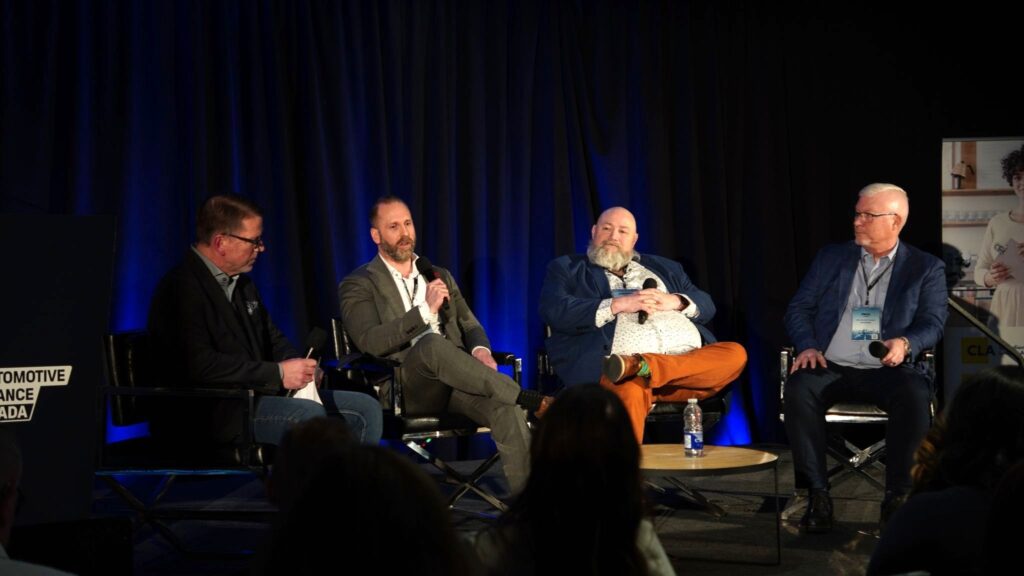
Abstract: In this panel on fraud, credit risk, and collections in Canadian auto lending, David Fry (CEO, Paays) moderated a discussion with Stephen Dykau (CEO, Santander Consumer Canada), Andrew Mulroy (VP Operations, iA Auto Finance), and Paul Hunsley (Head, Automotive Finance, Eden Park) on how lenders are responding to a market shaped by bust-out fraud, macroeconomic pressure, and rising portfolio stress. The panel explored why bust-outs remain one of the most damaging and difficult fraud patterns to catch, how lenders are adapting credit and collections strategies to a more volatile environment, and why dealer-lender transparency remains essential in non-prime lending. Across prime, near-prime, and non-prime perspectives, the takeaway was clear: there is no single fix for today’s losses, and stronger outcomes will depend on better data, better processes, and closer alignment across the ecosystem.

👉 Check out the full VIDEO here.
David Fry: There are still people in lending who say they don’t have any fraud. I usually respond by asking whether we can talk about their credit losses. Let’s start with bust-outs. If there’s one issue causing some of the biggest losses right now—whether at origination or inside the existing book—it’s probably bust-outs. Stephen, maybe start with the problem itself and how it shows up in a lender portfolio.
Stephen Dykau: Bust-out fraud is a really complicated problem. There’s no silver bullet here. What makes it so difficult is that on the face of it, these applications often look perfectly fine. They’ve passed ID verification, the bureau looks clean, and there’s nothing obviously derogatory that tells us not to proceed.
What’s really happening is that we have a data gap. When we pull the bureau, we can’t see in real time that another lender may have already funded an auto loan for that same customer. There’s a delay in reporting, and that lag is one of the biggest weaknesses in the system.
So part of the solution has to be more timely and accurate information—whether that comes from bureaus, portals, or other third-party sources. But even without that, we’ve also tried to improve our internal pattern recognition. We’ve looked at losses in our own portfolio and asked: what combinations of factors were present that might have helped us identify this earlier? There’s no single attribute, but there are combinations of things that can raise suspicion. We’ve trained our credit, income, and funding teams to escalate those cases to a more specialized fraud prevention team, and from there we may do secondary checks, pull the bureau again later, or look at registry data to see if something else has already been funded elsewhere.
David Fry: One follow-up there. We’ve heard a lot about expiring visas, temporary work permits, and what Patrick Boudreau called “departure defaults.” Are you seeing that correlation in your own portfolio too?
Stephen Dykau: There is some correlation there, yes, but I wouldn’t say it explains everything. It’s part of the picture, but not the whole picture. The previous panel made the point well: synthetic fraud is a real problem too. So while there’s overlap with departure-type cases, it’s broader than that. It’s not just one source of risk.
David Fry: Drew, let’s shift away from fraud for a minute and talk more broadly about credit performance. We’re living through what feels like a new shock every day. How has that environment affected your portfolio, and how are you adapting from a model and risk perspective?
Andrew Mulroy: The way I think about it is that we’re all floating on a raft. Risk appetite is the starting point. You need to know what your risk appetite is, and then your policies and processes all need to align to it. That alignment is critical.
And then on top of that raft now sits fraud. In non-prime, fraud was not really a major issue until about two years ago. Then suddenly it was. Bust-outs, departure fraud, true-name fraud—they’re all there, and they’re now constant factors in the book.
So you need fraud tools, you need strong partners, and you need testing. Constant testing. Segment testing, profile testing, scenario testing—whatever helps you understand whether the portfolio is behaving the way you expect under stress. Then sitting underneath all of that is collections. In times like this, if you don’t have a strong collections team, your raft doesn’t stay afloat very long.
David Fry: That’s a good segue, because Paul, collections is where a lot of this eventually lands. If macro events are affecting borrowers’ ability to pay—whether those loans were originated today or are already on book—how are you thinking about collections flexibility and adaptation?
Paul Hunsley: We spend a lot of time in auto finance talking about market share, penetration, and win rates. That’s all exciting. But it’s also all expense until someone actually starts paying us back. We don’t start recovering our economics until Jane or John Doe has an account number and begins making payments.
So if we’re not thinking seriously about how to protect the portfolio when strange events happen, we’re missing a huge part of why we’re in business.
What I’ve learned in near-prime is that our customers are actually pretty resilient. They’ve been through things before. They often know how to work through problems if we’re willing to work with them too.
That led us to explore some solutions outside our normal comfort zone. One was third-party live collections—not just written-off accounts, but active accounts where external support can help us scale quickly while our internal team focuses on the hardest files. That’s worked well for us.
But some of it is also just about basics. If the business plan says we need 50 collectors, we need 50 people in the seats. Otherwise we’re already failing. And beyond staffing, we implemented a deeper training process. Collections has a lot of turnover, and when you lose people quickly, you keep starting over. By improving training, reducing turnover, and retaining more experienced staff, we’ve seen better performance.
David Fry: Since you mentioned process and scale—Paul, is AI playing any role in collections for you now, or at least on the roadmap?
Paul Hunsley: It’s on the roadmap. We’re not a huge shop, so we still do a lot of things in a fairly traditional way, though we’ve become much more open-minded over the last few years.
What’s interesting about Eden Park is that we had already signed up with a lot of vendors who were ahead of their time, even if we weren’t fully using everything they offered. So now we’re looking at ways to apply newer tools to more mundane, repetitive work—like helping customer service teams make notes faster, move through calls more efficiently, and reduce some of the administrative burden. That’s where we’re focused right now.
David Fry: Stephen, pulling on that same thread—Santander is part of a very large global bank. How is AI showing up in your Canadian operations?
Stephen Dykau: At the global level there’s definitely a strong push into AI. The bank believes in the technology. But it comes with challenges.
A lot of organizations have spent heavily on AI without seeing strong returns yet. There was a PwC survey recently that suggested fewer than half of AI deployments had produced positive ROI, and some studies are even more negative than that. So there’s been a lot of excitement and a lot of investment, but not always a lot of business value realized.
That said, I do believe in the technology. I just don’t think it’s ready to run end-to-end processes entirely on its own. Where I see real value today is in augmenting staff—helping agents be more productive, more informed, and more consistent.
For example, in collections, AI can transcribe live calls, summarize what the customer is saying, surface relevant policy guidance, and help an analyst think through the next step. But there’s still a human in the process exercising judgment. From a regulatory and compliance perspective, I’m not prepared to fully hand decisions over to a machine if I can’t fully explain how it got there.
David Fry: Drew, let’s talk about one of your favorite topics: income and employment misrepresentation. Not necessarily outright fraud every time, but at least some level of misrepresentation. How do you even begin to measure that problem, and then what do you do about it when the dealer’s message is still “give me speed and don’t put obstacles in the way”?
Andrew Mulroy: The challenge is that income misrepresentation has been around forever. People have always nudged their rent lower, their income higher, or their details just enough to improve approval odds. That’s the small-f fraud version of the issue.
The problem now is that the technology available to fake documents has become incredibly good. A human can still spot some obvious forgeries, but the newer tools out there can generate convincing payroll documents and supporting paperwork at a level that’s going to be very hard for the human eye to catch. So we’re looking at where we can partner with specialists who can help us detect this better—whether through technology, systems, or document analytics.
We know we’ve stopped some fraud. We catch strange-looking pay stubs and inconsistent packages all the time. But what we don’t know, we don’t know. And a lot of that misrepresentation still just ends up booked as credit loss. Some of it is small-f fraud from people who fully intend to pay but embellish a little to get approved. Some of it is much more serious organized fraud. The only way to improve is to work with partners who are true experts in that space.
David Fry: Paul, last one to you. If you could ask dealer partners for one or two things that would help you underwrite more of the good customers and stop more of the bad ones, what would that be?
Paul Hunsley: I think it comes down to transparency and alignment.
As a non-prime lender, we work with a lot of independent dealers. That’s a big part of our business. And the thing that always stands out to me is that we all operate in the same niche bucket. The pool of non-prime customers each month doesn’t swing wildly—it’s not like there are suddenly tens of thousands of extra deals available. We all know roughly what this market looks like.
So if we could just be more reasonable and more transparent with each other about what we’re trying to accomplish, we’d all do better. If I’m not telling a dealer why I don’t want to do business with them anymore, that’s not good for anyone. And if a dealer is knowingly sending us poor-quality deals, they’re limiting their own access to lenders over time.
There aren’t that many lenders who do what we do. We can all coexist in this space and make money, but only if we’re honest with each other and maximize the value of that relationship. That’s the biggest thing I’d ask for.
Here are 10 key insights from the panel:
Bust-out fraud remains one of the biggest current loss drivers
Panelists agreed that bust-outs are among the most damaging forms of fraud in lending portfolios today.
The biggest structural weakness is delayed data visibility
Lenders often cannot see recent approvals or funded loans in time to prevent multiple simultaneous hits across the market.
There is no single bust-out indicator
Successful detection depends on combinations of signals, judgment, and second-look processes rather than one obvious trigger.
Fraud is now a core part of non-prime risk management
What used to be a secondary issue has become central to portfolio performance over the last two years.
Risk appetite still has to anchor everything else
Even in a more volatile environment, lenders need clear alignment between risk appetite, process design, fraud controls, and collections.
Collections remains one of the most important defensive functions
Strong collections teams, proper staffing, and better training materially improve resilience when portfolios come under pressure.
AI’s most realistic near-term use case is augmentation, not replacement
Panelists saw value in AI tools that support staff productivity and judgment, but not yet in fully autonomous decisioning for sensitive workflows.
Income misrepresentation is becoming harder to detect manually
As document fraud becomes more sophisticated, human review alone is increasingly insufficient.
Some fraud still hides inside what gets reported as credit loss
Not all losses labeled as credit underperformance are actually credit in nature; some are really undetected fraud or misrepresentation.
Dealer-lender transparency is still one of the most important levers
In non-prime especially, better alignment and more honest communication between dealers and lenders can improve outcomes for everyone in the chain.
Sign up for the CLA Finance Summit Series