

 Event Insights
Investing in Resilience: Turning Municipal Climate Adaptation into Bankable Projects
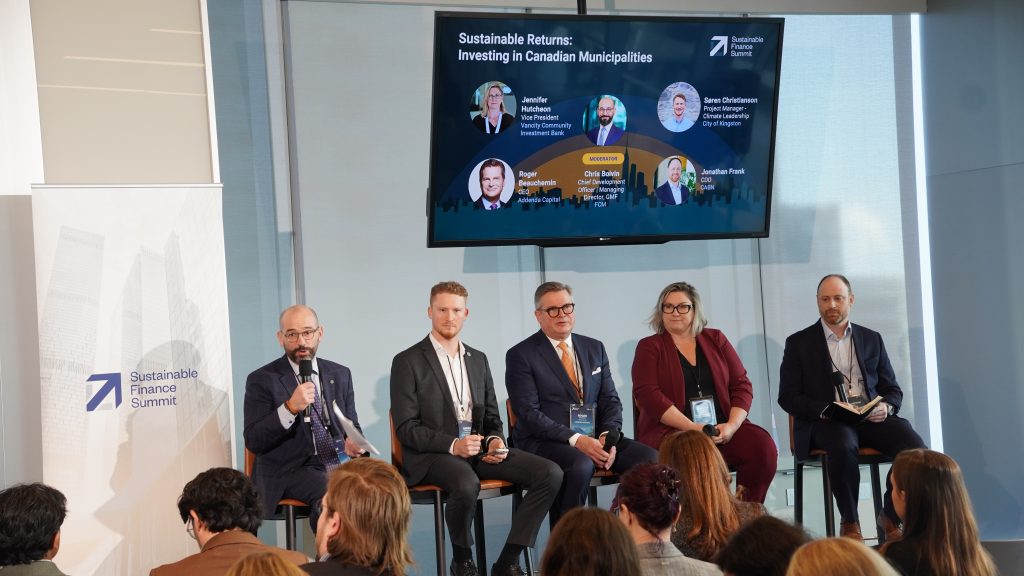
Abstract: This panel, moderated by Chris Boivin (Managing Director, Green Municipal Fund), unpacked what it really means to invest in climate resilience and why municipal adaptation is quickly becoming one of Canada’s most compelling investable opportunities. Panelists Roger Beauchemin (President & CEO, Addenda Capital), Jennifer Hutcheon (VP, Vancity Community Investment Bank), Søren Christianson (Program Manager, City of Kingston), and Jonathan Frank (Chief Development Officer, CABN) explored how stable municipal balance sheets, massive infrastructure ownership, and urgent climate impacts are converging to create a scalable pipeline for adaptation finance. The discussion emphasized that while the avoided-cost ROI of resilience can be 3–6x (and often 15–20x), unlocking private capital at scale requires blended finance structures, project aggregation, and trusted intermediaries like GMF to bridge public and private “languages.” The core message: resilience is no longer just a policy priority, it is a risk-adjusted, long-term investment thesis for lenders and institutional investors.

 Check out the full VIDEO here.
Chris Boivin: I’m Chris Boivin. I’m the Managing Director of the Green Municipal Fund. GMF works with communities across Canada to accelerate sustainable, low-carbon, and increasingly resilient investments. Fundamentally, we help municipalities and partners move from great ideas to bankable projects quickly.
We’ve been around for 25 years. We’re a global innovation as a model: mixing concessional financing with capacity development and partnering with other actors to advance municipal sustainability.
And in keeping with today’s theme, we all know climate change is more than mitigation now. We are seeing impacts every day. Everyone is talking about resilience. But what does investing in resilience actually mean? The interpretation is different if you’re a municipal stakeholder versus a lender or investor.
This session is about unpacking how we can turn resilience into concrete investable opportunities, unlocking strong risk-adjusted returns from scalable municipal projects and showing how public and private capital can come together to make adaptation finance not just feasible, but attractive to lenders and municipalities alike.
Why municipalities? They own a significant share of assets and infrastructure in communities across the country. They also influence other assets through services and utilities. When climate change impacts municipal services, that becomes business continuity and economic continuity.
Municipalities also represent some of the most stable borrowers in Canada. Their credit ratings are extremely strong. Yet many do not fully utilize their debt capacity, which creates an opportunity to unlock resilience investments that strengthen communities and Canada’s economy.
So the question is: how do we make that stability work for investors, lenders, and communities?
To start: What does investing in resilience really mean in practice, and why should it matter to commercial lenders and institutional investors who may not directly own physical assets?
Roger Beauchemin: As an asset manager, we invest on behalf of clients, mainly insurance companies, pension funds, and institutional investors. We touch roughly $42B and about 1.5M Canadians. We invest the money of Canadians for Canadians.
Our first order of business is fiduciary duty: financial return. But being attached to a cooperative insurer, we understand the reality of climate risk and the importance of mitigation and materiality in portfolio management.
We’ve been exploring resilience for about five years because climate change is already impacting Canadians and communities. Municipalities feel it every day. The question is how to bring private capital to bear, and that’s where blended finance comes in.
If private capital must charge for the risk it takes, the cost of capital can become too expensive. We need partnerships and structures like concessional pieces or loss guarantees.
Why do it? Because it is an “unsolved problem” and there is a strong investment case: for insurers, a rough rule is $1 in prevention can protect $10 in direct payouts. If you include indirect impacts like health issues or rebuilding sewer systems after floods, it can be closer to 1-to-20. If the project costs five, you still save fifteen. That is why we are involved.
Søren Christianson: From a municipal perspective, municipalities own and operate about 60% of critical infrastructure across Canada. We derive most of our revenue from property taxes, and there is very high demand for programs and funding.
The return on investment for avoided future costs from proactive resilience investment is at the very lowest 3–6x and can be 15–20x. This is a clear priority across Canadian municipalities.
In Kingston, we just completed our climate adaptation plan. Mitigation is still important, but municipalities are shifting focus to adaptation. We completed a multi-year pilot, Better Homes Kingston, focused on energy efficiency, deploying about $10M in capital.
We are limited in how much debt we can carry and how much we can invest, but demand remains high. We need to tap additional capital sources to scale.
Investing in resilience means being proactive, safeguarding communities, protecting building stock and commercial activity, and supporting business continuity. More broadly, it safeguards Canada’s long-term economic viability. This work happens on the ground at the municipal level, which is why it matters.
Chris Boivin: From a financing standpoint, what makes municipal investments attractive to commercial lenders and institutional investors?
Jennifer Hutcheon: From a lender’s perspective, municipalities are inherently low-risk borrowers. They have the capacity to administer programs like PACE and the broader tax base, which makes for secure lending.
That low-risk nature allows lenders to unlock creative and innovative programs, especially when partnering with organizations like GMF on pilot programs. Municipalities are also values-aligned for purpose-driven lenders like Vancity. The municipal sector is where we are happy to work to develop solutions that match climate priorities.
Jonathan Frank: Municipalities are attractive for a few reasons beyond stability.
First, they are long-term stewards and major asset owners. They think in decades of service delivery, not quarterly earnings, which supports resilient development.
Second, municipalities reduce project-level risk through local insights. They see climate impacts street by street, which translates into clearer pathways and more bankable outcomes. Programs like PACE and utility-led initiatives also have legitimacy that can boost participation.
Third, municipalities offer scale and pipeline certainty. They run capital plans and multi-year programs, creating repeatable deal structures and scalable opportunities.
So why isn’t private capital pouring in? Because the sector can feel fragmented and slow. Early-stage development risk still exists, and many resilience projects have added capex without incremental revenue, which complicates traditional debt models.
This is where GMF plays a key role as an origination partner that accelerates and de-risks projects, funding feasibility studies, pilots, and capacity. GMF can provide low-cost long-term loans, grants, and catalytic structures that crowd in private capital by aggregating deal flow at scale.
We should look beyond municipalities as borrowers. They are project partners, and GMF is a key enabler of investment-ready pipelines.
Chris Boivin: We’ve talked about why resilience investing makes sense. But what makes it investable at scale? How do we structure resilience investments so they balance competitive returns with measurable outcomes, giving lenders confidence and bringing credibility to municipal projects?
Roger Beauchemin: The problem is cash flows. Resilience cash flows are complex: savings are spread across insurance costs, avoided rebuilds, avoided disruptions, and more.
What’s powerful is that municipalities know where issues are, and GMF helps create the capital stack. You have to blend finance to de-risk these projects. Private capital needs the return required for the risk. We cannot concede returns for our clients, but our clients are thrilled when they can achieve strong outcomes alongside returns.
With a GMF structure or federal loss guarantee, private capital can participate. The other challenge is relationship-building. Investors need trust and understanding of municipal issuers. This has not been done at scale anywhere in the world. Canada has a unique chance to do it because we can coordinate and federate efforts.
Jennifer Hutcheon: Pilot programs are essential. You need a test-and-learn environment to prove what works, improve the model, and then scale. Once a model is proven, it becomes much more acceptable to financers and investors. Getting involved early in pilots is critical.
Søren Christianson: We are at a key turning point. Demand is significant. We have over 300 projects in our pipeline we want to scale through our PACE program.
GMF supports municipalities through program design studies, feasibility studies, business cases, and capacity development. In the public sector, we speak the language of risk mitigation and compliance, but it is not always the same language as finance. GMF bridges that gap.
Municipalities do move slowly, but we move safely. With trusted partners like GMF, projects gain confidence, trust, and political viability. If municipalities across the country do this, the scale becomes very large over a long horizon, offering safe, reliable, long-term returns in an increasingly unreliable world.
Chris Boivin: Final question. What are the most critical actions we need in the next five years to make resilience financing truly viable and profitable, on par with sectors like clean energy?
Jonathan Frank: We need to shift the financial model. Resilience often adds cost without added revenue, even with a creditworthy municipal counterparty. Clean energy had a key unlock with PPAs, but it also had two other drivers: technology cost declines and scaling professional services and institutional capacity.
For resilience, we need those similar building blocks: aggregate scalable projects across municipalities, and combine them with a blended finance pool backed by catalytic capital like GMF to crowd in private capital. This is how you de-risk, aggregate, and scale across the country.
Jennifer Hutcheon: My biggest action is partnerships. We financed PACE pilots with Ottawa and Switch PACE in Atlantic Canada. That unlocked comfort and lending capacity. There are many lenders ready to participate, but we need more connections and collaboration in the market to scale this nationally.
Roger Beauchemin: We are still stuck on the “what.” Many Canadians do not know what they are exposed to. A large portion of those most at risk are not aware.
Then we need scale, but perils differ: wildfire risk is different from flood risk, so scaling requires tailored models. Once that model exists, institutional capital will be there. I have spoken with enough asset owners to know the appetite is real if we can make it investable.
Søren Christianson: Three actions: come together, syndicate, and tap national scale. It makes no sense for each municipality to reinvent the wheel to attract capital. We are facing the same threats across jurisdictions.
Second: act fast and be proactive. The impacts are already here. In Kingston, over Halloween, we saw 70mm of rain in 36 hours, while typical November rainfall is 80–90mm.
Third: use trusted bridges like GMF to scale. Municipalities trust GMF. We want action. Let’s work together before we are saddled with more debt.
Chris Boivin: This is a unique opportunity at a pivotal moment for Canada. Economic resilience happens through our cities. The more resilient our cities are as places to work and live, the better positioned Canada will be in terms of competitiveness.
We are at time, so no Q&A, but GMF has a booth at the back. We would be happy to connect and discuss opportunities to collaborate and crack this nut. Thank you to our panelists.
Here are 10 key insights from the panel
- Resilience Is Now a Finance Imperative: Climate change has shifted from a mitigation-only story to daily, material impacts that require investable adaptation and resilience solutions.
- Municipalities Are Critical Economic Anchors: Municipal services and infrastructure underpin business continuity and economic continuity, making municipal resilience investments nationally significant.
- Municipal Borrowers Are Exceptionally Stable: Municipalities are among Canada’s strongest borrowers, often underutilizing debt capacity, creating room for scalable investment.
- The ROI of Resilience Is Compelling: Panelists emphasized avoided-cost returns that can be 3–6x at minimum and often 15–20x, especially when accounting for indirect impacts.
- Private Capital Needs Blended Finance to Participate: Resilience cash flows are diffuse, so catalytic tools like concessional capital and loss guarantees are needed to de-risk investments for commercial lenders and institutional investors.
- Project Aggregation Is the Scaling Unlock: Moving from one-off pilots to multi-municipality pools of replicable projects is essential to create investable scale and repeatable deal structures.
- GMF Bridges Public and Private “Languages”: Municipalities manage risk and compliance differently than financial institutions; GMF helps translate, structure, and accelerate projects into bankable opportunities.
- PACE Programs Are a Leading Pathway: Property Assessed Clean Energy models are a proven mechanism to deploy and scale retrofit and resilience capital through municipalities with strong participation credibility.
- Partnerships Drive Market Adoption: Lenders emphasized that pilot partnerships build comfort, prove models, and unlock broader participation across the financial sector.
- Canada Has a Unique Chance to Lead: The panel underscored that adaptation finance at scale has not been fully achieved globally, positioning Canada to innovate through coordination, blended finance, and national-level aggregation.
Sign up for the CLA Finance Summit Series