
 Sustainable Finance
Balancing the Books: Climate’s Impact on Financial Reporting
December 11, 2025
Balancing the Books: Climate’s Impact on Financial Reporting
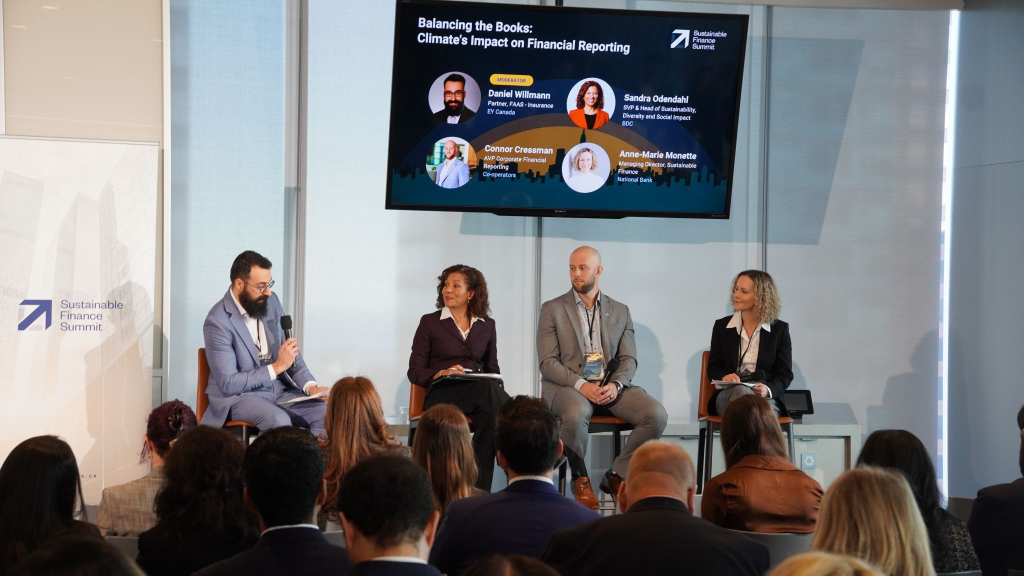
Abstract: This panel explored how climate considerations are rapidly reshaping financial reporting, risk management, and portfolio strategy across banking and insurance. Panelists Sandra Odendahl (former SVP Sustainability, Diversity & Social Impact, BDC and Board Member, Canadian Sustainability Standards Board), Anne-Marie Monette (National Bank Capital Markets), and Connor Cressman (Co-operators) discussed how climate risks are embedded in traditional financial risks, why data and disclosure must stay decision-useful, and how emerging tools like transition finance, physical risk modelling, and taxonomies are changing practice. The conversation highlighted the growing need to connect climate reporting with real strategic decisions, from asset-liability management to transition financing, while ensuring small and medium-sized businesses are supported with right-sized, pragmatic approaches to disclosure. Ultimately, the panel underscored that climate reporting is no longer just a compliance exercise, but a core driver of portfolio resilience and long-term value creation.

 Check out the full VIDEO here.
Daniel Willman: Our session today is titled “Balancing the Books: Climate’s Impact on Financial Reporting.” Over the next 30 minutes, we’re going to explore how climate-related factors are reshaping financial reporting and performance metrics. This isn’t just about compliance. It’s about resilience, transparency, and long-term value.
Joining me are three outstanding panelists from the insurance and banking sectors, with deep expertise in both sustainability and sustainability reporting. By the end of the session, we hope you walk away with practical insights on integrating climate risk into your organization’s strategy, aligning with evolving regulations, and positioning your organization for a sustainable future. Let’s dive in. Balancing the books is not just about good governance, it’s about good business.
To start, I’ll ask each of you to introduce yourselves and share how you and your organization are approaching climate-related financial reporting and sustainability overall. Anmarie, why don’t we start with you?
Anne-Marie Monette: Good morning, everyone. It’s a pleasure to be here. My name is Anne-Marie Monette. I’m a Managing Director in our Sustainable Finance and Advisory team at National Bank Capital Markets. Our team’s primary mandate is to support institutional clients in structuring sustainable finance instruments—such as green, social, and sustainability-linked bonds and loans—and in providing advisory services on broader sustainability topics.
We also work alongside our corporate-level partners to support sustainability and climate-related reporting, helping them understand regulatory expectations and investor needs. That integration between financing and reporting is becoming increasingly important, and I know we’ll get into that more as we go.
Connor Cressman: Hi, I’m Connor. I’m the AVP of Corporate Finance at Co-operators. I’m probably the only person here who can say that my day job is primarily financial statements and technical accounting assessments.
At Co-operators, we made a deliberate decision years ago that climate reporting should take on a financial-reporting-style lens. So while I focus on the financial statements, my team also issues our climate report. We work closely with our colleagues at Adenda, our sustainability team, and other partners who provide data and analysis, but the onus for climate reporting sits within the finance function under the guidance of our CFO. That’s a very intentional choice about how central this is to financial performance.
Sandra Odendahl: My name is Sandra Odendahl. I was, until recently, the Senior Vice President of Sustainability, Diversity, and Social Impact at BDC. I’ve been involved in corporate sustainability and sustainable finance for more than two decades—back from the days when we toiled in obscurity in risk management departments and when CDP submissions were only six pages long.
I also serve on the Board of the Canadian Sustainability Standards Board (CSSB). In that role, we’re focused on developing sustainability reporting standards that are truly decision-useful and financially material. I won’t go into all the details at this stage, but as we move through the discussion, I’ll speak to how both my former organization and the CSSB are thinking about climate reporting, materiality, and the practical realities of implementation.
Daniel Willman: I was told to make today controversial by starting with our personal opinions on U.S. politics—but I’m kidding; we won’t go there. Instead, let’s build on what we heard in the previous panel about the federal budget.
For each of you, in your day-to-day roles and priorities, was there anything in the budget that you’re focusing on or that you think will change your work as we move ahead?
Sandra Odendahl: Two things stood out for me. First, the changes to Bill C-59. I think the bill was well-intentioned—there was a clear need to rein in some of the more exuberant, and sometimes misleading, green claims coming from corporates. However, as we all know, it had the opposite impact and contributed to “green hushing.” I’m hopeful the adjustments we’re seeing now will soften that effect and encourage more transparent disclosures, not fewer.
Second, there were signals about moving toward more mandatory climate and sustainability disclosure. I think there’s a real necessity for that. Voluntary reporting has gotten us part of the way, but we need a clearer baseline to support comparability and decision-usefulness. Those are the elements I’m most excited about, along with a range of budget measures unrelated to climate that are still relevant for the economy.
Connor Cressman: Both of the points Sandra mentioned resonated with me. From a financial-reporting perspective, Bill C-59 is particularly interesting. When we did a market scan comparing 2023 disclosures to 2024, we saw a notable pullback—not only in marketing and social media content, but also in formal ESG and climate reports. Companies were clearly becoming more cautious.
Going forward, I think it’s going to be very important for businesses to “re-up” their game. For me, comparability and consistency are the most important features of any disclosure, financial or climate-related. Without those, disclosures are just numbers on a page. Once you can track trends over time and compare across companies, the information becomes genuinely useful for investors and other stakeholders.
The other area that stood out in the budget and earlier discussions is the work on a sustainable finance taxonomy. That ties directly into comparability and consistency. There is a lot of international guidance already, but it would be helpful to have something clear that domestic regulators like the CSA can point to directly for Canadian businesses.
Anne-Marie Monette: I’ll answer in two parts. First, at the corporate level, what’s changed in the last 12–18 months is similar to what Connor described. We’ve rolled our climate and sustainability reporting functions under our two co-chief accountants, with clear reporting lines into the CFO. That structure is meant to ensure we can comply with both existing and upcoming regulatory requirements, and that climate and sustainability are treated as core to financial reporting rather than a side initiative.
We’ve also been enhancing our capabilities in climate physical-risk modelling. We’ve onboarded new data providers to evaluate additional catastrophe types—ice storms, floods, wildfires—as these risks intensify. That shift is driven as much by the regulatory landscape as by risk management realities.
Second, on the budget itself, our work with clients shows how quickly new regulations are having an impact. For example, we’re already seeing the effects of climate-risk disclosure requirements in California, even with the recent delays announced for SB 261. Interestingly, that legislation—by framing disclosure in terms of risks and opportunities—has nudged some clients to look more seriously at opportunity lenses: product innovation, life-cycle assessments, and supply chain resilience.
We see clients working more closely across business lines—product development, R&D, sustainability—to integrate tools like life-cycle assessment and carbon accounting into product design, and to explore traceability solutions for more resilient supply chains. Amendments to C-59 that enable more balanced, opportunity-oriented communication can support this shift as well.
Daniel Willman: Sandra, let’s go a bit deeper with you first. Given your experience from the early stages of integrating climate considerations, how have you seen climate risks influence asset valuations and portfolio resilience? And how has climate-related reporting evolved over time to support those changes?
Sandra Odendahl: One of the biggest shifts over the past two decades has been the recognition that climate change is not a “new” risk category; it’s a driver of existing financial risks. I really liked the keynote’s framing of the risk pyramid—credit, legal, reputational, market, systemic risk. Climate change is a force that amplifies or alters those risks; it doesn’t sit in its own silo.
That was not intuitive even ten years ago. Climate risk was often treated as something separate and exotic. Now we increasingly understand that it’s deeply embedded in core financial risk frameworks.
On asset valuations and portfolios, I’d say the link between climate-related risks and asset values is still more qualitative than it needs to be. A lot of the discussion is still, “Intuitively we know this could be a problem—short, medium, or long term—but it depends on many variables.” We haven’t fully nailed down how those risks translate into specific valuation impacts across sectors and instruments. Some asset classes are easier than others, but overall there’s still a lot of work to do.
The other big evolution has been in who is in the room. When I started, climate conversations were dominated by scientists and engineers, with some bankers and portfolio managers leaning in early. Over time, the conversation has shifted into finance, management, and legal circles, which is mostly positive. But I worry that we’ve internalized a “more data is always better” mindset.
There’s a tendency to assume that if some data is helpful, then an order of magnitude more must be even better. That’s not always true. You don’t need to know the exact, down-to-the-gram carbon footprint of your nine-year-old car to know that a plug-in hybrid will emit less. You can manage many decisions with directional information.
In some areas, we may have “jumped the shark” with extremely complex methodologies. I was in a meeting on a GHG Protocol methodology for financed emissions from over-the-counter derivatives. It’s intellectually fascinating, but we have to ask: how will this be used in decision-making? What difference will it make to real-world emissions compared to more immediate, high-impact actions like reducing methane?
So yes, we needed more reporting. But more and more and more disclosure doesn’t automatically lead to better outcomes. At some point, we need to refocus on decision-usefulness and actually doing things, not just measuring them.
Daniel Willman: I think we’re still at the start of that journey—even though we’re decades in. We’re still figuring out what reporting really means for decision-making. Connor, let’s shift to you and bring in the insurance lens.
You work in an organization that’s both a life and P&C insurer. How are climate-related liabilities being reflected in your financial statements, and what challenges are you facing in trying to quantify those risks?
Connor Cressman: You touched on it in the question. Co-operators is somewhat unique in that we’re both a life insurer and a P&C insurer. Many large players are primarily one or the other. The insurance industry, at its core, is about risk management and pricing risk appropriately to support clients, earn a sustainable profit, and manage assets to meet obligations.
From a financial-statement perspective, there’s no explicit requirement today for “climate-specific” line items, but climate is embedded in many of the disclosures we already make. Take catastrophic events: they’ve always been there, but they’re more frequent and more severe now, and that’s changing our risk profiles.
I’ll reference a recent Sun Life report that showed spikes in group benefits claims—particularly mental-health-related leave, doctor visits, and prescriptions—around major events. While those impacts weren’t framed explicitly as “climate numbers,” they tie directly into established disclosures on mortality, morbidity, and catastrophic loss events.
In P&C, the impacts of physical risk—floods, wildfires, severe storms—are relatively easier to see and quantify. You have shorter-tail products, annual renewals, and can reprice more frequently.
On the life side, the challenge is different. How do you price the long-term health impacts of recurring wildfire smoke or extreme heat? When do you adjust your mortality or morbidity assumptions for a policy that may be in force for decades? If we don’t start understanding and pricing those impacts now, we risk mis-aligning our long-term reserves and capital.
To me, disclosures will follow the underlying actions. If we don’t take action to understand the impacts, we won’t be able to disclose them meaningfully. So the work really starts with internal analytics and risk management, not just the reporting template.
Daniel Willman: As you were speaking, you echoed something Sandra said: the room used to be full of scientists and engineers; now we see bankers, actuaries, and lawyers. There’s more cross-disciplinary engagement and interconnectedness.
Anne-Marie, from your vantage point at National Bank, how are climate reporting and climate finance becoming more interconnected—particularly in light of recent developments such as transition bond guidelines? And how is that shaping your approach with clients?
Anne-Marie Monette: Recent months have seen several important developments. We’ve heard about taxonomies and the federal budget, but at the same time we’ve had international market guidance evolving. You mentioned the climate transition bond guidelines published by the International Capital Market Association (ICMA). The month prior, the Loan Market Association (LMA), LSTA, and Asia Pacific Loan Market Association released a guide to transition loans.
These tools are interesting because they introduce “transition” labels that sit alongside green, social, and sustainability labels, and they’re specifically designed to enable financing for transition projects—particularly in hard-to-abate, high-emission sectors. These sectors are critical to the global economy and represent trillions of dollars of potential investment through 2050.
Where reporting and financing intersect is in the safeguards that come with these instruments. Transition-labelled projects must demonstrate substantial and quantifiable emission reductions, removals, or avoidances. That requires robust data and frameworks so investors can assess them and banks can underwrite them.
Borrowers or issuers are also expected to have a credible sustainability or climate transition strategy in place and to demonstrate alignment with market-based or jurisdictional taxonomies—whether that’s long-standing frameworks like CBI or emerging national taxonomies. This is where the Canadian transition taxonomy discussion in the budget becomes very relevant: finance tools and taxonomies are complementary, and both depend on coherent reporting.
Finally, there is an expectation that issuers assess the economic and technological feasibility of lower-carbon alternatives. That might involve third-party benchmarks and scenario analysis, but it also requires building internal capabilities. So there is a strong connection between reporting and enabling climate transition finance. For fossil-fuel-related infrastructure in particular, forward-looking metrics—key milestones, sunset clauses, and progress indicators—will be closely watched. Developments on both the reporting and financing fronts can help catalyze that market.
Daniel Willman: I’ve heard some recurring themes—data, tools, quantification. Sandra, let’s bring in the small and medium-sized enterprise (SME) perspective.
Are you seeing increased demand from SMEs for guidance on how to report climate-related risks and opportunities? And how have you supported them?
Sandra Odendahl: Over the last few years, we did see a rise in interest from Canadian small and medium-sized companies in sustainability reporting—not just climate, but also social topics. Many of them were asking, “How do we do this in a way that’s proportionate to our size and resources?”
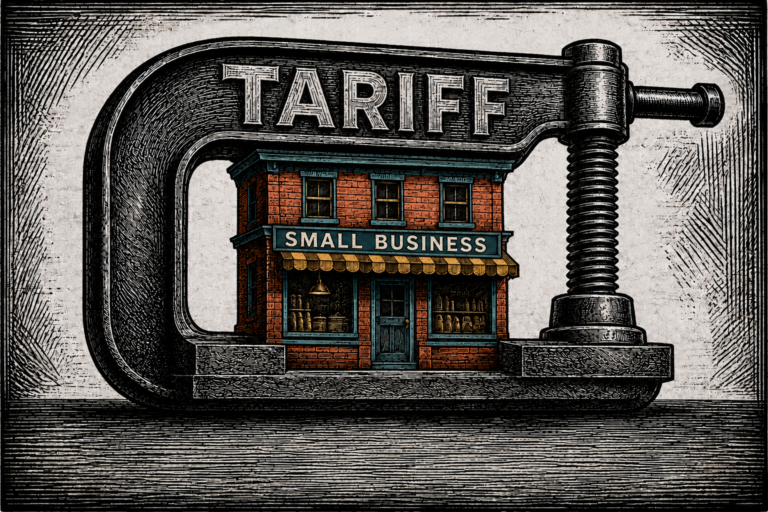
In the last year, though, many SMEs have been focused on staying alive in the face of tough economic headwinds—tariffs, inflation, and general uncertainty. For a lot of domestic-oriented SMEs, the priority has shifted back to basics.
However, for companies that export to Europe or are in the supply chains of large global brands—think Nestlé, IKEA, Siemens—sustainability and climate reporting are still very much on the agenda. Those firms have to respond to supplier questionnaires and align with more demanding expectations on emissions, supply-chain impacts, and product-level footprints.
So while Canadian SMEs have historically been very focused on domestic and U.S. markets, that’s changing quickly. As they diversify and do more business with Europe and other regions, they are once again being pulled into disclosure and climate-reporting conversations. It’s a tumultuous period on many fronts, and reporting is very much part of that story for export-oriented SMEs.
Daniel Willman: Anne-Marie and Sandra, you’ve both touched on supporting clients. Connor, let’s talk about how you “herd the cats” internally.
You’re pulling together data and disciplines across Co-operators to produce climate-related reporting that hasn’t historically lived in the financial statements. How have you approached that?
Connor: I’ll split it into two components: our own operational emissions and our “insurance-associated” or financed emissions.
On the financed/insurance-associated side, the biggest area for many insurers is the emissions linked to the investment portfolio. I don’t want to steal the thunder from the next panel, where our investment manager’s CEO will be speaking, so I’ll focus on the insurance-associated side.
A big advantage for us is that the person leading our sustainability reporting team is an accountant by training who used to do reconciliations, financial statements, and financial controls. That mindset has shaped our approach.
For example, when we calculated insurance-associated emissions for our commercial auto portfolio, we leveraged data from our underwriting systems—policy details, vehicle types, etc.—and combined that with standardized emissions factors to calculate emissions. That gives us a headline number, but the real work is validating it.
We try to tie those emissions back to our financial results so we can be confident that they represent our business accurately. We’re constantly asking: Is the data consistent, repeatable, and—ideally—auditable in the future? That’s where we’ve spent much of our time: quality, controls, and ensuring that what we report can stand up to scrutiny. As an auditor, that makes me happy.
Daniel Willman: We’re almost out of time, so let me close with one question for each of you.
Are there any innovations or best practices in climate-related financial reporting that you think would be especially valuable for this audience? Sandra, let’s start with you.
Sandra Odendahl: I’ll mention two things, both a bit controversial. First, I think we’re going to see a return to pragmatism. The pendulum has swung very far in some jurisdictions—particularly south of the border—and not always in a wise or constructive way. We do need robust climate disclosure and risk management, but we also need to remain grounded in materiality and decision-usefulness.
That’s one of the things I appreciate about the CSSB. We have a diversity of views around the table, but we’re aligned on the goal: develop reporting standards that are decision-useful and financially material. That focus is hard enough on its own, and it keeps us from chasing every possible metric just because it’s measurable.
Second, we need to keep asking: “If we gather this piece of data, what decisions will it inform? How will it change outcomes in the real economy?” Some of the more esoteric financed-emissions methodologies—for example, for over-the-counter derivatives—may be mathematically elegant but have limited impact on real-world emissions relative to more immediate opportunities. So pragmatism and impact-orientation are the innovations I’d most like to see.
Connor Cressman: I’ll try to be brief and build on that. For me, the innovation is embedding sustainability properly into strategic decision-making.
In insurance, a concrete example is asset-liability management. Insurers have to manage their assets to back their liabilities. We now have transition-risk information on our assets—sector exposures, alignment metrics, scenario analysis. The next step is embedding that information into decisions about asset mix, risk appetite, and capital allocation.
That’s where climate data stops being a separate “ESG report” and becomes part of core financial decision-making. I think the organizations that succeed will be the ones that identify specific, strategic use cases where climate information actually changes portfolio or product decisions.
Anne-Marie Monette: I’ll offer a related but different example. I think location-specific information for physical and nature-related risks is going to become increasingly important. It’s not only about direct asset damage; it’s also about second-order impacts—business continuity, supply-chain disruption, revenue loss.
Access to better geospatial data, satellite imagery, and nature-risk analytics will help us assess those risks more directly and integrate them into financing and risk decisions. The challenge—and opportunity—will be to turn that data into usable tools for clients, not just more complexity.
Ultimately, the most valuable innovation is anything that helps us make better decisions with the information we already have and focus on where climate risk is most material.
Daniel Willman: You all did an excellent job staying (almost) on time. Thank you for your insights, and thank you to the audience for your engagement.
Here are 10 key insights from the panel
- Climate as a Core Financial Risk Driver: Climate change is not a “new” risk category; it amplifies existing financial risks such as credit, market, legal, reputational, and systemic risk, and must be embedded within those traditional frameworks rather than treated separately.
- From Voluntary to Mandatory Disclosure: Budget and regulatory developments, including adjustments to Bill C-59 and moves toward more mandatory climate and sustainability disclosures, are pushing organizations toward clearer, more comparable reporting baselines.
- Data Must Be Decision-Useful, Not Just Abundant: There is growing concern that ever-increasing data and complex metrics are not always linked to real-world decision-making, underscoring the need for pragmatic, financially material, and impact-oriented disclosures.
- Insurance Shows Climate Embedded in Liabilities: In both P&C and life insurance, climate impacts are already embedded in existing disclosures (e.g., catastrophe losses, morbidity and mortality trends), even if they are not labeled as “climate” line items—highlighting the need to connect long-term climate effects with financial assumptions.
- Transition Finance Is Reshaping Market Labels: New guidance on climate transition bonds and transition loans is expanding the toolkit beyond traditional green and social labels, enabling financing for hard-to-abate sectors provided projects have credible transition plans and measurable emissions impacts.
- Taxonomies and Standards Need to Align: Emerging Canadian taxonomies and CSSB standards are seen as complementary tools that can anchor climate finance and reporting, improving comparability for issuers, lenders, and investors across jurisdictions.
- Physical and Nature Risk Are Becoming Location-Specific: Improved geospatial and catastrophe data are allowing institutions to model physical and nature-related risks (floods, wildfires, ice storms, biodiversity loss) at more granular levels, with implications for underwriting, lending, and portfolio resilience.
- SMEs Face a Dual Pressure: While many Canadian SMEs are currently focused on economic survival, those in export-oriented supply chains—especially with European or global anchors—are under rising pressure to provide right-sized climate and sustainability disclosures.
- Embedding Climate into Strategy Is the Real Innovation: The leading practice is shifting from stand-alone ESG reports to integrating climate information into concrete strategic decisions, such as asset-liability management, capital allocation, and product design.
- Pragmatism and Impact Over Perfection: A recurring theme is the need to balance ambition with practicality—focusing on disclosures and metrics that can realistically inform decisions and drive emissions reductions, rather than pursuing measurement complexity for its own sake.
Sign up for the CLA Finance Summit Series