

What Ottawa Can Learn from European Fintech
April 16, 2026

What Ottawa Can Learn from European Fintech
How Europe spent a decade building the rails of modern finance while Canada is still debating the blueprint
I just spent a week in Burgundy drinking far too much good Pinot Noir. Somewhere between the vineyards, I managed to have long lunches with friends working in banking and fintech across Europe. In this article I try to noodle on what can we learn from our friends across the pond …
On the flight back to Canada, I started jotting down notes. What struck me most was not that Europe simply has stronger fintech companies. Canada has no shortage of strong founders, lenders, payment innovators, and financial institutions. The real difference is that Europe has spent the better part of a decade building the infrastructure and policy architecture that allow innovation to scale. In Canada, we are still playing catch up.

This is particularly true in payments and lending, where Europe has moved much more quickly to treat financial infrastructure as a strategic economic asset. The practical lessons for Canada are becoming increasingly obvious, and they go far beyond the (now-tired) open banking conversation.
At the heart of Europe’s lead is something deeper than product innovation. It is policy design. Over the past decade, Europe has built a coherent framework that links payments, data portability, resilience, and identity into a connected financial ecosystem.
A few policy pillars stand out:
- PSD2, and now PSD3 / PSR: Europe did not stop at first-generation open banking. It is already moving into the next phase of payment rules, API standards, and fraud prevention.
- Instant Payments Regulation: real-time payments are increasingly being treated as a baseline utility rather than an innovation layer.
- DORA (Digital Operational Resilience Act): Europe has created a common framework for cyber resilience, third-party technology risk, and outage management across the financial sector.
- FiDA (Financial Data Access): the conversation has already moved beyond open banking toward open finance, where data portability extends into lending, investments, insurance, and small-business finance.
- SEPA and cross-border interoperability: money can move across multiple jurisdictions with far less friction than in Canada.
Taken together, these are not isolated fintech policies. They form an ecosystem that lowers friction across the entire credit lifecycle, from payments to underwriting to servicing.
This is where Europe’s experience becomes especially instructive for Canada. We continue to discuss consumer-driven banking as though it is the destination, when in reality it is only the starting point. Europe has already moved from open banking toward open finance, and that shift things enormously.
Imagine a small business applying for working capital and being assessed on live operating cash flow rather than last quarter’s statements. Imagine automotive finance moving beyond static affordability checks at the dealership toward real-time income verification and bank-transaction analysis. Imagine mortgage underwriting where verified financial data can move with the consumer rather than being rebuilt from scratch every time they shop a file. In many parts of Europe, this is no longer hypothetical. It is increasingly becoming standard practice.
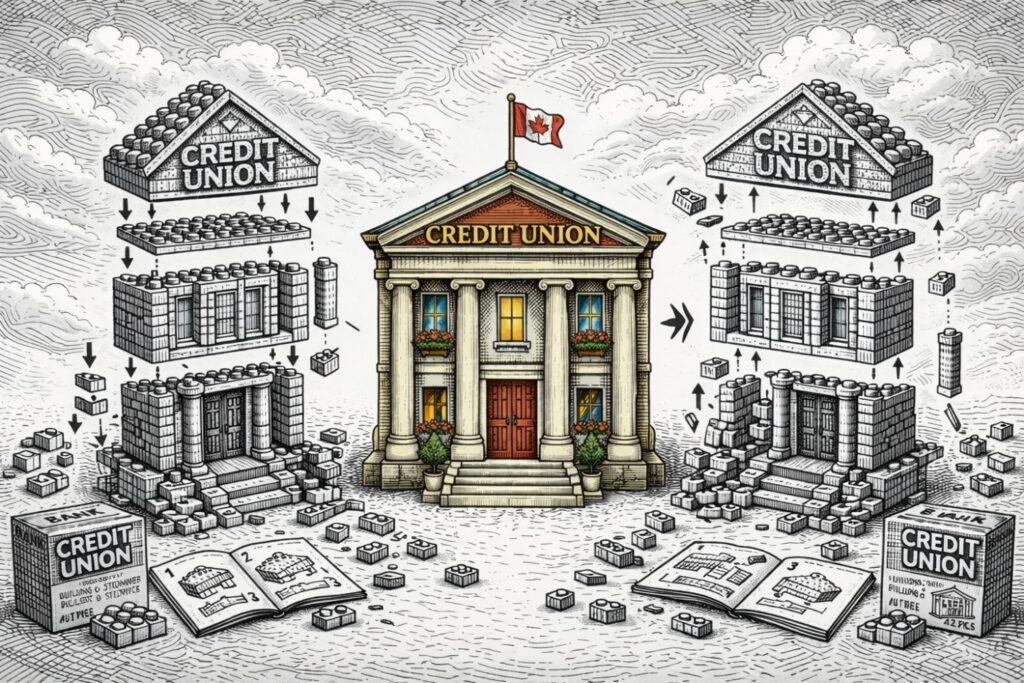
That is the lesson Canada needs to heed. Fintech is not merely about apps, startups, or a better front-end experience. It is about the rails underneath the system: payments, identity, data portability, interoperability, and increasingly resilience. Once those rails exist, innovation tends to follow naturally. Without them, everything becomes slower, more expensive, and harder to scale.
This is particularly evident in payments. Across Europe, moving money instantly and across borders has increasingly become normal. Europe no longer treats instant payments as innovation. It treats them as table stakes. Canada, meanwhile, is still waiting for the Real-Time Rail.
That delay matters far beyond payments themselves. Faster payment rails improve liquidity for small businesses, reduce settlement friction for merchants, and create richer data for lenders. They improve affordability checks in automotive finance and can streamline rent, mortgage, and real-estate payment flows. Payments are not simply a standalone category. They increasingly sit at the centre of modern lending and commerce.
So what is holding Canada back?
Part of it is structural. Canada has one of the most stable banking systems in the world, but stability can sometimes come with inertia. A concentrated market with highly trusted incumbents naturally moves more slowly than a fragmented market under greater competitive pressure.
Part of it is regulatory. Canada has spent years studying, consulting, and debating open banking, while Europe moved earlier, legislated sooner, and improved through implementation. Europe’s willingness to legislate, learn, and iterate has allowed it to move from PSD2 to PSD3 and from open banking to FiDA while Canada is still operationalizing the first phase.
But I think the bigger issue is “I am sorry” mindset. Canada still too often treats fintech as a sector. Europe increasingly treats it as infrastructure.
That is the real lesson from across the pond.
5 Key Notes:
1. Europe built infrastructure first
Europe’s lead comes from building the rails beneath innovation: payments, APIs, identity, interoperability, and resilience frameworks. Canada is still in the early stages of building comparable infrastructure.
2. Open banking is already evolving into open finance
While Canada is still operationalizing consumer-driven banking, Europe has already moved toward broader financial data portability across lending, investments, insurance, and SME finance.
3. Real-time payments are now table stakes
Instant payments and cross-border interoperability are standard across much of Europe. Canada’s delayed Real-Time Rail continues to constrain innovation across commerce and lending.
4. Better rails drive better underwriting
Live transaction data, real-time income verification, and portable financial profiles are transforming small-business lending, automotive finance, and mortgage origination across Europe.
5. Canada must change its mindset
The core lesson is strategic: Europe treats fintech as infrastructure, while Canada still too often treats it as a sector. The next decade will belong to the jurisdictions that build the pipes, not just the apps.
Sign up for the CLA Finance Summit Series

















 Event Insights