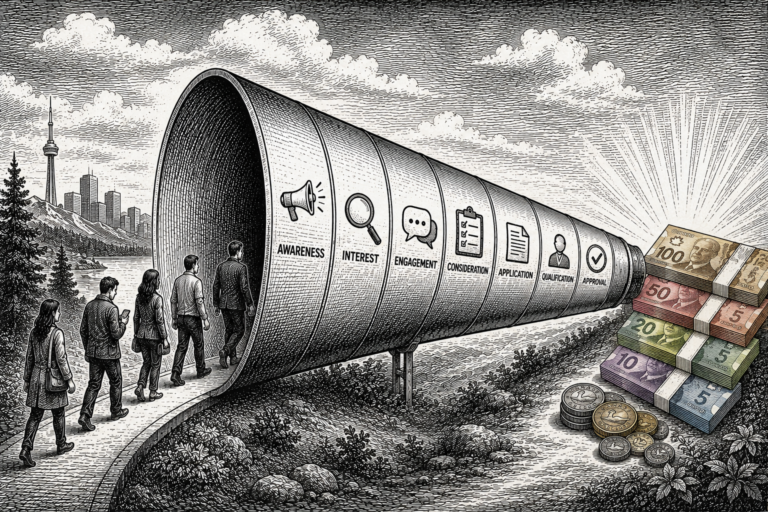


Abstract: Canadian lenders invest heavily in assessing risk before they extend credit. The harder test comes later, when a customer’s circumstances change. Collections is where a lender must turn risk insight into an appropriate response: timely contact, a workable option, or a conversation with someone equipped to help. AI can improve those decisions, but only if it sits within an operating model that connects data, policy, digital channels and human judgement. The measure of progress is not more automated activity. It is better, more sustainable resolutions for customers and lenders.
Collections has never been the glamorous end of lending. It has also often received less strategic attention than acquisition and credit decisioning. When a customer struggles to pay, the discussion can narrow quickly to arrears and recovery, overlooking something important: the lender’s response shapes trust and the customer’s ability to resolve the problem.
That separation has never made much sense. A customer’s ability to pay can change after even a sound lending decision. One person may face illness, unemployment, a higher housing payment or a temporary cash-flow problem. Another may simply need a convenient reminder. Treating both with the same standard message or payment demand is efficient only on paper.
Canada illustrates why precision matters. The Bank of Canada’s 2026 Financial Stability Report finds that households have been resilient overall and that most borrowers renewing mortgages at higher rates have managed the increase. It also identifies pockets of greater financial pressure. The lesson for lenders is not to prepare for every borrower to fall behind. It is to recognise differences early enough to respond appropriately.
That is why collections should be considered a critical part of customer service. It is the part of the relationship where a lender’s promise to understand and support its customers is tested under pressure. That is not a side issue. It is the customer relationship.
Lenders can see more signals of financial difficulty than before. That is progress, but an early warning in a risk report does not help a customer by itself. Someone still has to decide when to make contact, what to say and whether specialist attention is needed. Insight matters only when it changes what happens next.
Consider a mortgage customer whose expected payment will rise at renewal. A lender might identify the change months ahead. A risk label is not a treatment. The useful decision is what to do with that information: consider the customer’s circumstances, communicate clearly before difficulty escalates and make relevant support accessible.
That response should look very different from the one for a customer who has missed a payment because a direct debit failed.
For federally regulated institutions, this is also an operational question. The Financial Consumer Agency of Canada’s guideline on existing consumer mortgage loans in exceptional circumstances sets expectations for identifying early signs of severe financial stress, proactively contacting consumers at risk and assessing appropriate, individualised relief. A policy can establish those expectations; servicing and collections teams must be able to carry them through each customer journey.
The sequence is straightforward, even if executing it well is not: recognise a relevant signal, select an appropriate next step, give the customer a usable path to resolution and check whether the outcome holds. If a payment arrangement fails a few weeks later, the process should learn from that result. If a customer repeatedly abandons a digital journey, that too is information. The path offered may not be working.
Lenders should ask a tougher question of their collections strategies: did the intervention help produce a sustainable outcome, or did it merely move an account through a workflow?
Give AI a role …
AI is most useful here when it has a clear job to do. It can help prioritise cases, distinguish customers with different needs, recommend a contact channel or treatment, and bring relevant account history together for a collector. That is the kind of AI I find useful: technology that helps a team make a better next decision, rather than technology in search of a problem.
The interesting questions are not only what AI can do, but where it should stop. Which actions may be automated under an approved policy? Which recommendations must a collector review? What triggers a handoff when a customer disputes a balance, describes hardship or needs an exception? And how will a leader know whether a recommended treatment was fair and effective across different groups of customers?
Some customers prefer the privacy and convenience of exploring an option digitally. Self-service can also free specialists to focus on complex cases. But self-service should not become a dead end. Keeping a distressed customer inside an automated conversation is not success. Sometimes the best next action is a prompt handoff to a trained person with the context and authority to help.
The strongest collections operation is not digital or human. It is digital access, governed decision support and human judgement working together. It should measure more than contacts made or short-term cash collected. It should examine whether customers reached the right support, whether arrangements endured and whether collectors had what they needed to handle difficult cases well.
Collections has long had a public image defined by pressure. From the outside, it can still look like little more than people chasing overdue payments. After more than two decades in this field, I have met many collections professionals who are doing something far more difficult: balancing recovery, customer circumstances, policy and judgement in real time.
Lenders have an opportunity to change the image of collections through those everyday decisions. AI and technology can help make appropriate action easier, human help more accessible and results more durable. That is a more demanding standard for collections. I think it is also a better one.
Collections is where a lender’s customer promise is tested. It is a lender’s moment of truth.
Five key takeaways
- Collections is part of the customer relationship, where a lender’s promises are tested when circumstances change.
- Canada’s household debt picture calls for differentiated responses to pockets of stress, rather than one treatment for every borrower.
- Early risk detection creates value only when it leads to timely, appropriate action and accessible support.
- AI should have a clear role: helping teams prioritise, recommend and learn within clear policy and human oversight.
- Sustainable resolutions, usable customer journeys and informed collectors matter more than activity alone.