

From Kitwe to Lagos: Africa’s Financial Plumbing
March 25, 2026

From Kitwe to Lagos: Africa’s Financial Plumbing
Why the next phase of African fintech will be defined by infrastructure, integration, and the movement of capital, identity, and talent across borders
Abstract: Africa’s next technology opportunity is not simply more apps or more digital access. It is the infrastructure that allows money, identity, talent, and trade to move more efficiently across borders. The continent has already shown it can leapfrog legacy systems. The next phase is about integration: connecting fragmented markets, enabling trusted identity, financing small businesses more intelligently, and building solutions that can scale across Africa and outward to the rest of the world.

I was born in Kitwe, on Zambia’s Copperbelt, in a place shaped by industry, trade, and movement. Even then, the flow of goods and money rarely aligned. Value was created locally, but the systems needed to move capital, extend credit, or scale businesses beyond borders were fragmented or absent.
Decades later, after building a career in Canada and investing companies in Lagos and in Nairobi, that same structural gap remains. But the context has changed. Africa has made enormous progress on financial inclusion. Mobile money, digital wallets, and fintech platforms have brought hundreds of millions into the financial system. Payments, at least at the consumer level, are no longer the primary constraint.
The next phase is different. It is not about access alone. It is about infrastructure.
The most important opportunities in African fintech today are not new apps or marginal improvements to user experience. They are the harder, less visible problems underneath: how money moves between countries, how businesses are identified and trusted, how credit is extended without traditional collateral, and how fragmented systems are connected into something coherent.
Trade
Nowhere is this clearer than in trade. Despite decades of policy ambition, intra-African trade still accounts for only about 16% of Africa’s total trade, far below the levels seen in Asia, at roughly 59%, and Europe, at roughly 68%. One reason is the continent’s persistent infrastructure deficit. Another is financing. Africa continues to face a trade-finance gap of roughly US$100 billion, leaving many local manufacturers and distributors without the liquidity needed to scale. Too often, banks still view cross-border African trade as too risky, even when the underlying commercial opportunity is clear.
The African Continental Free Trade Area promises to change that. But policy alone does not move goods. Payments do. And neither policy nor payments are enough if firms cannot fund inventory, manage counterparties, or build trusted commercial relationships across borders. For a small business in Accra trying to buy inventory from Nairobi, or a distributor in Lagos sourcing from Johannesburg, the friction is not demand. It is execution. Cross-border payments remain slow, opaque, and expensive. Currency conversion is inefficient. Settlement can take days. Trust is often manual.
This is where a new generation of infrastructure companies matters. Some focus on payments and foreign exchange. Others are building the deeper financing and trust layers that make trade possible for smaller firms. Woveo Africa is a good example. The platform is built around powering intra-African trade for small businesses through purchase-order financing, escrow payments, trade credit building, and wallet-based financial services. Its platform is designed to help SMEs access working capital, reduce counterparty risk, and build a verifiable credit profile through actual trade activity.
That matters because one of the real constraints on intra-African commerce is not simply the movement of money. It is the financing and trust gap that sits alongside it. Small businesses often lack the liquidity, protections, and transaction history needed to operate across borders with confidence. Platforms such as Woveo are trying to close that gap by making trade finance, escrow, and credit-building part of a single commercial flow. In doing so, they are helping move cross-border trade beyond policy ambition and into day-to-day execution.
The deeper issue is credit. Many African SMEs operate with real demand and real cash flow, but without the formal records or collateral traditional lenders still expect. The result is a persistent missing middle: businesses too large for microfinance but too informal for banks. The future of lending in Africa will have to be built less on static collateral and more on transaction data, operating history, identity, and embedded finance inside the commercial systems where businesses already work. Firms that can capture real operating data, rather than rely only on formal balance sheets, will be far better placed to finance the continent’s growth businesses.
Identity
But credit does not scale without trust. Without reliable identity, there is no scalable credit system. Without trusted verification, there is no efficient compliance framework. Yet the next phase of the identity problem is no longer confined to KYC and AML at the customer edge. Increasingly, the vulnerability is moving inside the institution.
That is why the conversation is beginning to shift from KYC to what might be called KYE, or know your employee. Gartner’s recent research points in that direction. In July 2025, Gartner reported that employers are finding it harder to assess candidates’ true abilities and, in some cases, even their identities. It found that 6% of candidates admitted to interview fraud and predicted that by 2028 one in four candidate profiles worldwide will be fake. It also warned that candidate fraud can create cybersecurity risks far more serious than a bad hire.
This matters well beyond HR. In financial services, the chain of trust now runs through employees, contractors, outsourced workflows, privileged access, and internal systems. The weak point is no longer only the fraudulent customer at onboarding. It may be the falsified recruit, the compromised employee, the contractor with the wrong access, or the insider who knows exactly how to work around controls.
In that sense, identity is no longer just an onboarding issue. It is becoming an enterprise-risk issue. That is the practical substance of KYE, even if the terminology is still evolving. The market is heading toward a broader trust architecture, one that covers not just customers and transactions, but also workforce integrity, access governance, and internal anomalies.
This is where companies like Identify Africa, based on Nairobi, matter. Their relevance is not limited to front-end onboarding or compliance workflows. The larger opportunity is to help build a stronger identity layer across the financial system itself.
Skills
But integration is not only about goods, money, and trust. It is also about labor.
Platforms like LaborHack, based in Lagos, are tackling another structural inefficiency: the mismatch between demand for skilled blue-collar labour and the fragmented systems used to find, vet, train, certify, and deploy that labour across markets. LaborHack has built a marketplace focused on construction, real estate, and facility-management talent, connecting employers with skilled workers while improving quality through vetting, certification, and workforce management.
That makes it more than a job board. LaborHack is helping formalize labour, make skills more legible, and give employers greater confidence in the quality of the people they hire. In sectors where informality and weak verification often create friction, that is a meaningful form of infrastructure.
Its partnership with Passage, based in Toronto, points to something larger. By helping African workers access education financing, migration support, and study-and-work pathways into Canada, LaborHack is helping turn local skills into portable economic capital. It is not only helping workers secure local gigs. It is helping make skilled labour exportable across borders.
That is the broader point. In the next phase of African growth, talent will function more like infrastructure. The ability to identify, certify, finance, and move skilled workers across jurisdictions will matter almost as much as the ability to move money.
Interoperability
But even that is not enough without interoperability.
Africa has built multiple successful financial ecosystems. The problem is that these systems do not connect easily to one another. Wallets are fragmented by country. Payment rails are not standardized. Data does not travel well across institutions or borders.
The continent solved much of the last-mile problem. It has not yet solved the system-to-system problem. Without interoperability, scale remains constrained. Businesses cannot expand regionally with ease. Financial products do not travel well. Costs stay high, and trust has to be rebuilt market by market.
What ties all of this together is a shift in perspective. For years, African fintech has been viewed through the lens of inclusion. That lens is no longer sufficient. The more important question now is integration.
How do systems connect across borders? How does data become portable and usable? How do capital, trade, and talent move efficiently to where they are needed?
The answers will not come from any single country. They will emerge between markets. This is where the opportunity becomes more compelling. Africa is not only a recipient of financial innovation. It is becoming a source of it.
Companies built to solve for fragmented infrastructure, weak identity systems, trust gaps, and cross-border complexity are, by necessity, designing for resilience and adaptability. Those capabilities are increasingly relevant well beyond the continent. Whether it is identity verification, trade finance, cross-border payments, or talent marketplaces, African-built solutions are beginning to travel outward.
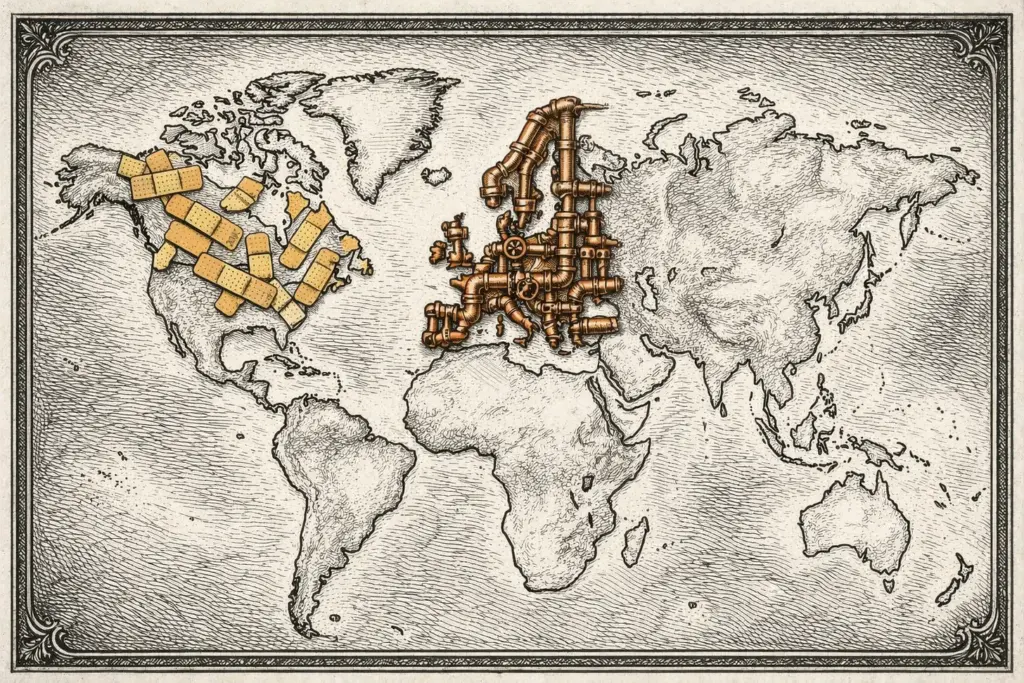
This two-way flow, bringing technology into Africa while also expanding proven African solutions globally, may ultimately be one of the continent’s greatest advantages. The opportunity is enormous. But it requires a shift in mindset. Africa does not need more fintech apps. It needs financial plumbing. And the firms that build it will not just serve the continent. They will help define the architecture of global finance in the years ahead.
Disclosure: The author is an investor in LaborHack, Identify Africa, and Woveo. He also serves as Executive Chair in these businesses.
Five Key Points
- Africa’s next fintech opportunity is infrastructure, not interfaces.
The first chapter was access through mobile money and digital wallets. The next chapter is about the systems underneath. - Intra-African trade is one of the continent’s biggest untapped opportunities.
Cross-border payments, trade finance, trust frictions, and settlement delays continue to hold back SME growth and regional commerce. - Credit in Africa will increasingly be built on cash flow and operating data, not traditional collateral alone.
The financing challenge is not just a lack of capital. It is a lack of usable, portable, and trusted data. - Identity is expanding from customer verification to enterprise trust.
The next major risk is not only KYC at the customer edge, but also KYE-style concerns around workforce identity, insider risk, and institutional trust. - Africa is not just importing innovation. It is beginning to export it.
Solutions built to solve African market constraints are increasingly relevant globally, and that outward expansion is central to the continent’s long-term success.
Sign up for the CLA Finance Summit Series
















 Event Insights