

Canada’s Growing Shadow Credit Market: Balancing Consumer Access, Affordability and Lending Risk
Abstract: My article argues that Canada’s credit system is no longer centred solely on banks, as private credit funds, fintech lenders and specialty finance firms now play an increasingly important role in financing consumers, small businesses and real estate. The real policy challenge is not the growth of non-bank credit itself, but the fact that regulators have less visibility into how this broader system is functioning. Rather than trying to force new lenders into a bank-style model, policymakers should focus on modernizing the information architecture of the credit system through better data, better reporting and a clearer view of emerging risks across the wider lending ecosystem.
This week’s speech by the Governor of the Bank of Canada, Tiff Macklem, carried an understated but important message. The architecture of Canada’s credit system is changing faster than the institutions that oversee it.
For decades, policymakers could treat banks as the centre of gravity of the financial system. If regulators understood the banks, they largely understood the system. That assumption no longer holds.
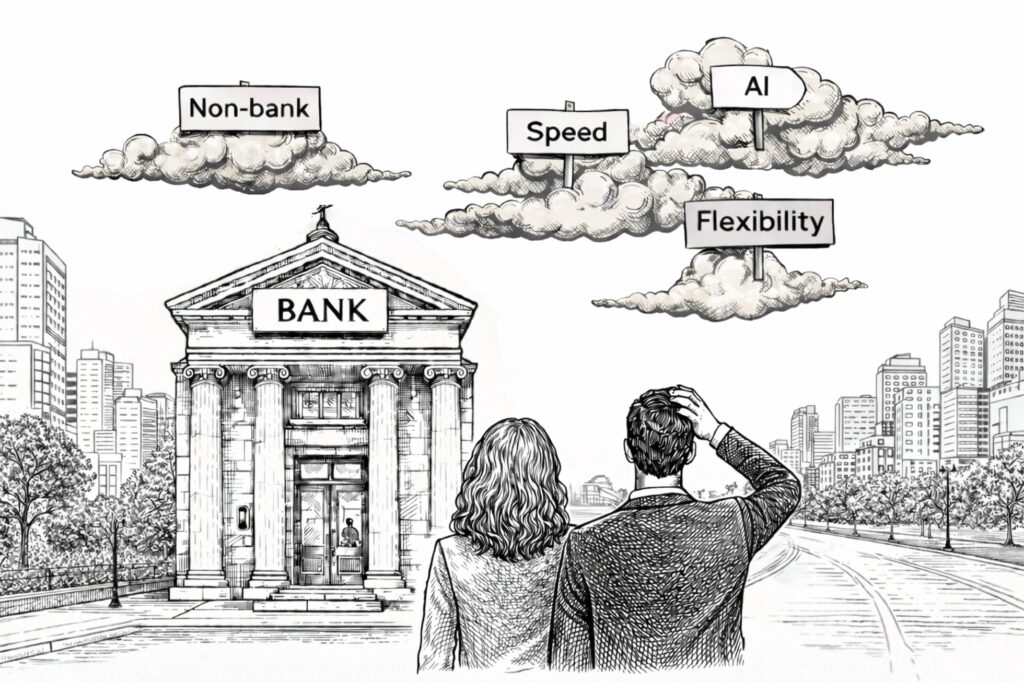
A growing share of credit now originates outside traditional banking institutions. Private credit funds, fintech lenders and specialty finance firms increasingly provide capital to small businesses, consumers and real estate projects. This shift is not unique to Canada. Across the developed world, non-bank lenders have moved from the periphery of finance to a more central role in credit creation.
The problem, as Mr. Macklem observed, is that regulators can see far less of this system than they once could.
Private markets are opaque by design. Loans are not traded daily. Valuations are not constantly marked to market. Data is dispersed across hundreds of firms rather than concentrated within a handful of banks. As a result, the growth of private credit has created a paradox for policymakers. The financial system may be more diversified than before, but it is also harder to measure.
This opacity has prompted warnings about “shadow banking,” a phrase that still carries the ghosts of the 2008 financial crisis. But the analogy is often misleading.
Unlike the complex securitisation chains that helped fuel that crisis, much of today’s private credit is relatively straightforward lending. In Canada, non-bank lenders finance equipment purchases, merchant working capital, vehicle loans and small-business expansion. They serve segments of the economy that banks often approach cautiously or cannot reach efficiently.
In other words, the rise of private credit reflects not a malfunction of the system but a natural evolution of it.
Banks remain essential. But they are no longer the sole channel through which credit flows. The modern financial system increasingly resembles an ecosystem rather than a hierarchy, with banks, fintech lenders, private funds and institutional investors all participating in the allocation of capital.
That diversity brings benefits. When one channel tightens, another can often expand. During periods of economic stress, such diversification can make the system more resilient.
The risk lies elsewhere.
If regulators lack visibility into large parts of the credit system, they may struggle to detect emerging vulnerabilities. Leverage may accumulate in unexpected places. Funding pressures in private markets could ripple outward during a downturn. Weaknesses may build quietly until they are difficult to contain.
The answer is not to suppress private credit. Nor would it be wise to regulate fintech lenders as if they were deposit-taking banks. The better approach is to modernise the information architecture of the credit system itself.
Policymakers need better visibility into how credit is being originated, financed and distributed across the economy. That does not require heavy-handed supervision. It requires better data, better reporting and a clearer view of how risks move across the broader lending ecosystem.
Industry groups and regulators could work together to develop aggregated reporting on portfolio performance, delinquency trends and funding structures in non-bank lending. The goal should not be to force every lender into a bank model, but to ensure that policymakers can see enough of the system to understand where vulnerabilities are building.
In short, the challenge is informational rather than structural. Canada’s financial system is no longer defined solely by its banks. It is defined by a broader network of institutions that collectively supply credit to the economy. The task for regulators is to ensure that they can see that system clearly enough to understand its risks.
Mr. Macklem’s speech was therefore less a warning than an invitation.
The era of bank-centric finance is quietly ending. The next phase of financial stability policy will depend on how effectively regulators learn to work with the lending ecosystem that is replacing it.
5 key insights
-
Canada has moved beyond a bank-centric credit model
Non-bank lenders and private credit are now an established part of the financial system, not a marginal side market. -
The biggest risk is informational blind spots
As credit creation disperses beyond traditional banks, regulators have less direct visibility into leverage, funding pressures and emerging weaknesses. -
Today’s private credit is not simply a replay of 2008-era shadow banking
Much of the current market involves more direct, plain-vanilla lending rather than the complex securitisation structures associated with the global financial crisis. -
The system is becoming more diverse, and potentially more resilient
A broader mix of banks, fintech lenders, private funds and institutional capital can help sustain credit flows when one channel tightens. -
The policy answer is better data, not blunt suppression
Canada needs modernised reporting and stronger visibility into non-bank lending so regulators can understand risks without treating all non-bank credit as if it were banking.






 Event Insights