

The Moment of Intent Is Up for Grabs
August 20, 2026
Gary Schwartz Canadian Lenders Association

How AI and Open Banking Are Transforming Borrower Acquisition by Turning Intent Into Opportunity
Abstract: Lenders may not need more leads. They need to do a better job converting the borrowers already showing intent. As consumer-driven banking makes financial data more portable and AI makes borrower engagement more intelligent and immediate, competitive advantage is shifting from simply owning customer data to acting on it at the right moment. The lenders that can combine AI with deterministic controls, compliance guardrails and human judgment will be better positioned to reduce friction, improve conversion and capture borrowers when the need for credit actually emerges.
Today we held the Canadian Lenders Association’s first Acquisition Roundtable. It is somewhat remarkable that it took us this long. At the CLA, we have sector-based roundtables that go deep into individual lending verticals, as well as cross-sector roundtables that serve all of our lines of business around issues such as risk and servicing. But we had never really attacked the front of the funnel: how you find the right borrower, engage them when they actually need credit and turn that moment of intent into a funded relationship.
What struck me during today’s discussion was how quickly we landed on AI. Not AI in underwriting, not AI reading documents or summarizing credit files and, thankfully, not another conversation about chatbots. We were talking about AI at the very front of the lending funnel. I came away thinking that we may be looking at the AI opportunity in lending from the wrong direction.
This may sound slightly heretical coming out of an acquisition roundtable, but lenders do not necessarily need more leads. They need to stop losing the borrowers they have already paid to find. One of the points raised today was just how extraordinary the leakage can be between a digital lead entering the funnel and a funded borrower coming out the other end.
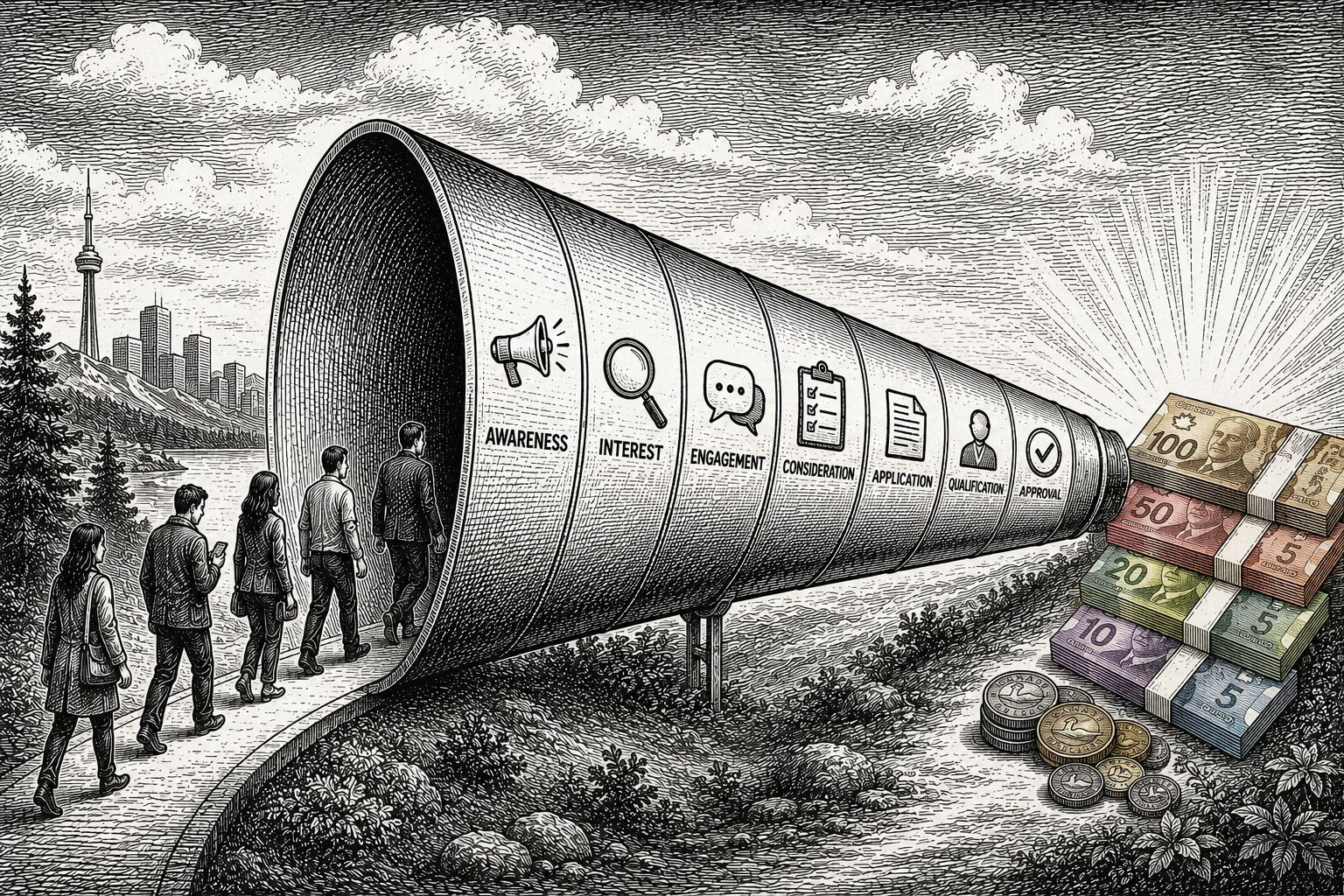
For years, the response to that problem has been fairly predictable:
- Buy more traffic.
- Improve targeting.
- Generate more leads.
- Spend more on search.
Then put all that additional demand into essentially the same leaking funnel.
We have spent enormous amounts of money making credit decisioning smarter while the experience at the front door has changed surprisingly little. A borrower arrives on a website and gets a form. A small-business owner starts thinking about financing at 9 p.m. and there is nobody available to answer a basic question. A mortgage prospect wants to understand what they can afford but has to provide considerable information before getting anything useful back.
In many respects, the customer-facing side of lending still looks uncannily like it did 20 years ago.
This is where AI starts to become interesting from an acquisition perspective. It can engage the borrower when the financing need actually emerges, understand what they are trying to accomplish, ask the right questions, identify missing information and help determine which product may be appropriate. It can move the borrower further into the process before a conventional application is ever completed, and hand the conversation to a human when judgment is actually required.
There is a certain familiarity to this. About 20 years ago, during the mobile revolution, I wrote a book titled The Impulse Economy about the opportunity to use the mobile phone to engage consumers at the moment of intent. The technology has changed considerably, but the underlying opportunity has not. The advantage comes from being present when the need emerges, with enough context and intelligence to make that moment useful.
One phrase from today’s roundtable captured this particularly well: the moment of intent is up for grabs.
Borrowers do not think in terms of lending funnels. They have problems they are trying to solve:
- Can I afford this house?
- Can I buy this vehicle?
- Can I make payroll?
- Can I consolidate these payments?
Historically, the lender often enters the picture only after that need has been translated into an application. AI creates the opportunity to enter the conversation earlier, while the borrower is still trying to understand the problem and what options are available.
That matters because intent is fleeting. A borrower who cannot get a useful answer from one institution can move somewhere else almost instantly. The lender that can understand the need, provide relevant guidance and begin determining whether there is a viable lending opportunity has an obvious advantage over the lender waiting for a completed application to arrive.
Consumer-driven banking makes this considerably more interesting. Many financial institutions still view it primarily as a regulatory or compliance exercise, but I think that understates what is happening. It could become one of the most important changes to borrower acquisition in Canadian financial services.
Historically, the institution that held the customer relationship also held most of the useful financial context. As consumers gain the ability to permission their financial information to other providers, that advantage begins to erode. Competitive advantage starts shifting from who owns the data to who can actually use it intelligently when the consumer needs something.
This is where AI and consumer-driven banking begin to reinforce each other:
- AI can understand intent.
- Permissioned financial data can provide context.
- Deterministic rules can establish what is permissible.
- Human judgment can enter when it is genuinely required.
Together, they allow a lender to have a much more useful conversation much earlier in the borrower journey.
The objective is not simply to persuade more people to apply. It is to determine whether there is a viable lending opportunity, steer the borrower toward the right product and help the right customer move forward.
That has very real implications for acquisition economics. Every borrower who abandons an application costs money. So does every prospect routed to the wrong product, every unqualified applicant pushed too far through the funnel and every customer who becomes frustrated and leaves. Even modest improvements in conversion can materially change customer acquisition costs, particularly when those improvements are being made against traffic the lender has already paid to generate.
But this was also where today’s discussion became more complicated. Winston Morton from Climative, which works with financial institutions using AI-driven property data to support retrofit financing, loan origination and HELOCs, made an important point. In his experience, large banks are eager to talk about AI, but become considerably more cautious when AI is put directly in front of the customer.
The concerns are understandable. Banks have to think about bias, privacy, non-deterministic outputs, liability and where a human needs to remain in the loop. His distinction between deterministic and non-deterministic decisioning is therefore an important one.
The AI may be non-deterministic, but the rules around it do not have to be.
That distinction matters because the bottleneck may no longer be the intelligence of the technology. It may be the confidence of the institution deploying it. Banks do not need another presentation telling them that AI is transformational. They need evidence showing where it works, where the guardrails belong, which decisions should remain deterministic and where a human genuinely needs to stay in the loop.
Climative’s suggestion that the industry develop shared frameworks and draw lessons from successful implementations struck me as exactly the kind of work we should be doing through the CLA. The more clearly institutions understand where AI can operate safely and where it cannot, the more confidently they will be able to deploy it.
That also turns the conventional relationship between innovation and compliance on its head. Compliance is often treated as something that slows innovation down. In this case, stronger controls may be exactly what allows institutions to move faster. The lender with the clearest guardrails may ultimately be able to use AI more aggressively because it has greater confidence in the boundaries around the technology.
For decades, the acquisition model in lending has been relatively linear:
Marketing found the borrower → the borrower applied → credit decided whether the lender wanted them.
That sequence is beginning to collapse.
AI can understand intent. Permissioned data can provide context. Deterministic rules can begin qualification. Human judgment can enter when it is actually needed.
The acquisition funnel is becoming a decision engine.
That was probably my biggest takeaway from our first Acquisition Roundtable. The question for lenders is no longer simply how to generate more leads. It is how to recognize the right borrower, understand what they need and move them intelligently through the journey while their intent is still alive.
That moment of intent is increasingly up for grabs.
5 Key Points
- The acquisition problem is increasingly a conversion problem. Lenders may get more value from reducing leakage than from simply generating more demand.
- The moment of intent is becoming the battleground. AI allows lenders to engage borrowers when the financing need actually emerges.
- Consumer-driven banking changes the acquisition model. As financial data becomes portable, advantage shifts from owning data to acting on it intelligently.
- Institutional confidence is becoming the real AI constraint. Banks understand the opportunity, but need clearer guardrails around reliability, privacy, bias and accountability.
- Compliance can become an acquisition advantage. Deterministic controls can give lenders the confidence to automate more of the borrower journey without giving up governance.















 Event Insights